

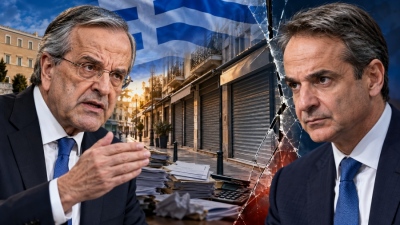
Fierce criticism of the government economic policy was voiced by Antonis Samaras, speaking of a deep crisis in small and medium-sized entrepreneurship.
He called for a reduction in energy costs and indirect taxes, the reinstatement of VAT in catering to 13%, and dedicated financing for small businesses.
A direct attack on the governmental economic policy was unleashed by Antonis Samaras, on the occasion of his address at the Conference of the Federation of Professional, Craft and Commercial Associations of Messinia, in Kalamata.
The former prime minister described a particularly difficult situation for small and medium-sized enterprises, arguing that the real economy faces a deep and structural crisis.
Fiasco with the installments
Mr. Samaras maintained that the operating cost of an SME increased by 35% within the last two years, while sharply criticizing the settlement frameworks for private debts.
As he stated, the 72-installment measure «failed miserably», since, according to the data he cited, less than 10% of enterprises participated.
He also expressed reservations regarding the new 120-installment framework, noting that fines, surcharges, and an interest rate approaching 6% curtail the possibilities for meaningful settlement of obligations.
«Huge competitiveness deficit»
The overall productive model of the country came under fire from the former prime minister.
Citing data on the current account balance and the financial state of enterprises, he spoke of a severe deficit in competitiveness and productivity.
At the same time, he argued that out of the country’s roughly 900,000 SMEs, barely 70,000 possess creditworthiness, demonstrating, as he said, the scale of the problem.
Neoliberal government
Antonis Samaras described the issue as deeply political, emphasizing that governmental choices determine which sectors economic policy supports and which productive model is advanced. Indeed, he contrasted today’s governmental approach, which he described as «managerial, neoliberal», with the social liberalism he himself advocates.
The three measures he proposes
The former prime minister requested immediate support measures for SMEs, presenting three key priorities.
First, the reduction of energy costs, which significantly burdens enterprise operations.
Second, the reduction of indirect taxes, with particular emphasis on restoring VAT in catering to 13%, a measure that, as he recalled, had been implemented during his own government’s tenure.
Third, he proposed the creation of a National Fund or a Special Purpose Bank, with financing dedicated exclusively to small and medium-sized entrepreneurship.
Closing, Antonis Samaras reassured professionals that he stands firmly at their side, sending a message in favor of strengthening SMEs and the real economy.
The address of the former prime minister
Specifically, in his written address for the 100 years of the OEBES Messinia (Federation of Professional, Craft and Commercial Associations of Messinia), he emphasized: «Your Conference takes place during a difficult juncture.
Small and medium entrepreneurship is confronting a major historic challenge.
Historic, because while you constitute the backbone of the Greek economy, in recent years the sector has been facing a deep and structural crisis. The data speak for themselves.
The cost increase for an SME, only during the last two-year period, reached a staggering 35%…!
The 72-installment measure for private debt failed miserably.
Not even 10% of businesses ultimately took part in it.
Moreover, the first indications for the new 120-installment framework are discouraging.
Because, with the fines, surcharges, and an interest rate touching 6%, every possibility for a meaningful solution to the problem is thwarted.
Shock deficit
At the same time, and this is unfortunately deliberately kept silent, the current account deficit has exceeded 9 billion euros!
We are talking, in other words, about a massive deficit in our country’s competitiveness and productivity.
Today, the IMF ranks Greece in 172nd place, out of a total of 190 countries on this matter...
Let me only recall that since 1948, our country had a positive balance in only one single year: in 2013!
Let me further add that of the 900,000 SMEs, barely 70,000 have creditworthiness…
The issue is not solely economic.
It is deeply political.
Because it is a political decision which sectors of the economy you strengthen or weaken, where you rely and where you do not.
It is a political decision regarding the productive model of the country.
It is a political decision whether you care or are indifferent to the social consequences of your economic priorities.
I answer with social liberalism
Against, therefore, the managerial, neoliberal policy pursued by the current government, I choose social liberalism.
This means you cannot care only about macroeconomic performance through excessive surpluses, which are generated mainly by high indirect taxation.
Nor must you encourage the cartelization of the economy at the expense of small and medium-sized entrepreneurship.
Particularly in times of social and economic crisis in the real economy.
Three measures, proposals
On the contrary, the adoption of immediate and emergency measures to support small and medium entrepreneurship is required.
I will cite, indicatively, three of them:
First, immediate interventions to lower the cost of energy.
Second, the reduction of indirect taxes.
I wish at this point to insist on the need for the reduction of VAT in Catering.
VAT in Catering must return to 13%, which during my administration I established, and indeed against the Troika back then, a measure which succeeded completely and in fact yielded more revenue.
Third, the financing exclusively of small and medium entrepreneurship, through a National Fund or a Special Purpose Bank.
With these thoughts, I wish you to have a constructive and candid dialogue at your Conference in our Kalamata, and to reassure you that I stand firmly at your side.»
O Peiraiarxis
www.bankingnews.gr



Σχόλια αναγνωστών