

The revelation by BN regarding the damning report by DG AGRI on the ongoing fraud at OPEKEPE clearly pleased no one.
Neither the government primarily, nor the European Commission, which appears to prefer sweeping the filth under the rug while officials engage in political horse-trading.
This is evident from the fact that we forced them to react—albeit in the manner they did—following intense pleading by Margaritis Schinas.
The convenient compromise
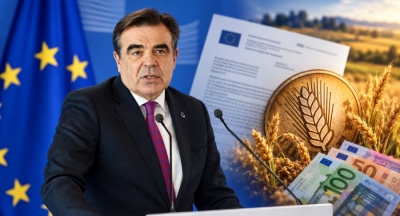
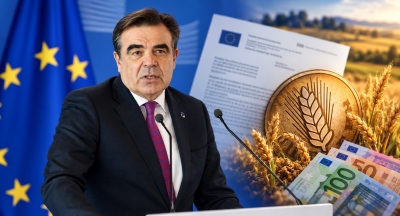
It is undeniable that in his bid to salvage himself over the last 24 hours, Margaritis Schinas urgently pleaded with his old associates in Brussels for breathing space from the devastating findings that humiliate both the government and him personally.
He managed to obtain an outcome that suits both parties, yet amounts to absolute nothingness: an unsigned non-paper that Margaritis Schinas and the government will market as the official position of the European Commission to the domestic audience, but which binds the European Commission in no legal way whatsoever.
After all, aides close to Margaritis Schinas were already boasting that the European Commission was officially replying.
The response from «nobody»
Yet a non-paper effectively means that nobody is responding.
In contrast to an official audit letter carrying verified signatures and formal recipients, we are handed an inconsequential piece of scrap paper lacking authorship, signature, or name.
It mirrors the briefings circulated by political parties and corporations when attempting to seed misleading narratives to media outlets, spread disinformation, and speculate without assuming public accountability.
Content remains what matters
The essence is that the audit letter contains shocking, verifiable findings.
These cannot be annulled regardless of how many anonymous non-papers are circulated.
The document outlines systemic corruption across every administrative tier, substantiated by documented evidence.
For those who need reminding: a non-paper is defined as an informal, usually anonymous memo distributed without a signature or official seal.
It does not constitute a formal, public, or legally binding stance of its author.
It bears no authorial credit, organizational logo, or signature, functioning purely as an off-the-record instrument to steer reporting without political exposure.
We persist...
Here at BN, we take pride in our investigative journalism and our disclosures.
We will continue pursuing them regardless of how uncomfortable it makes figures in power, treating responses via anonymous non-papers with the skepticism they warrant.
Journalism is publishing what someone else does not want published; everything else is public relations.
The parody non-paper
For the record, here is the full non-paper with our observations in parentheses:
«The European Commission, responding to questions from journalists (whom did they ask and who is answering?), emphasizes the following:
In recent months, the Greek government has taken decisive measures to improve the management of Common Agricultural Policy (CAP) funds and approaches the issue with utmost seriousness. (They fail to specify what these measures are, leaving the public uninformed).
Greek authorities regularly brief the European Commission on progress achieved in implementing the Action Plan.
For its part, the Commission assesses progress and issues recommendations regarding necessary further steps. (Where severe misconduct substantiated by evidence is simply rebranded as "recommendations").
Significant progress has been made, yet work remains to be done.
Regarding the letter to which you may be referring, this does not represent the final position of the European Commission (dismissive rhetoric paired with implicit threats). It constitutes a preliminary, administrative, and technical step and should not be interpreted otherwise (though funding cuts remain on the horizon). It forms part of the standard audit procedure applied across all Member States. (Where chronic administrative failure is normalized as routine procedure).
In this specific instance, it concerns legacy problems of the past (how they are resolving them when nothing has been executed this year through October, following a July audit, remains a mystery) for which we are working collaboratively.
Cooperation between Greek authorities and the services of the European Commission remains highly constructive». (Constructive enough that irregular practices continue unabated).
Nikos Karoutzos
nkaroutzos@gmail.com
www.bankingnews.gr







Σχόλια αναγνωστών