

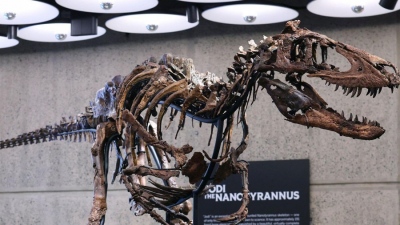
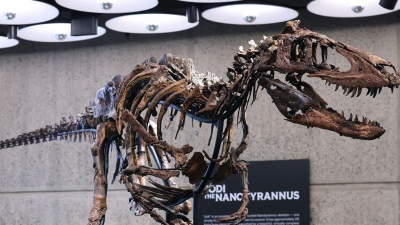
The skeleton of an exceptionally rare Nanotyrannus dinosaur was sold at a Sotheby's auction in New York for 47.3 million dollars, following a 12-minute bidding battle among six potential buyers. The sum far exceeded the initial estimate of 6 to 9 million dollars, while bringing the fossil within a hair's breadth of the record sale price for a dinosaur skeleton at auction. The find, named Jodi, constitutes one of only three relatively complete Nanotyrannus skeletons known to the scientific community. Its sale, however, reignites strong reactions from paleontologists over the commercial exploitation of rare fossils, as private acquisitions risk removing them from museums and restricting the scope for scientific study.
A rare skeleton worth 47.3 million dollars
Jodi stands approximately 2.93 meters tall and measures nearly 5.97 meters in length—slightly more than half the length of Gus, an extraordinary Tyrannosaurus rex (T. rex) skeleton that sold in July for 50.1 million dollars, establishing the world record for a dinosaur fossil. According to Sotheby's, Jodi's skeleton is preserved in exceptional condition and consists of 191 bone elements, including an almost complete skull. Based on its overall size and bone development, the specimen is estimated to be a fully grown adult. The skeleton was discovered in 2019 by rancher Jodi Pierson in Montana, after whom it was named. Excavation was carried out by Clayton Phipps, a commercial paleontologist known by the moniker "Dinosaur Cowboy." Part of the missing bones has been replaced with custom-fabricated elements via 3D printing and sculpting. Furthermore, the fossil was sold with full rights, allowing the new owner to produce and distribute replicas of the skeleton to museums or private collectors. The identity of the buyer has not been disclosed.
The dispute over whether Nanotyrannus was a distinct species
Beyond the staggering price, Jodi holds particular significance for paleontology, as the very existence of Nanotyrannus as a distinct species remains a subject of scientific debate. For years, researchers argued over whether fossils attributed to Nanotyrannus actually belonged to a smaller cousin of T. rex or represented juvenile individuals of the Tyrannosaurus rex species itself. Only recently has the scientific discussion begun shifting in favor of the view that Nanotyrannus constituted a discrete dinosaur species. Within this context, access to well-preserved specimens, such as Jodi, is considered exceptionally vital for further investigating dinosaur taxonomy.
The Montana discovery and the "Dueling Dinosaurs"
Jodi originates from the Hell Creek geological formation, a region spanning Montana, Wyoming, and the Dakotas that has yielded major dinosaur fossils. It was there in 1902 that one of the first T. rex skeletons was discovered, helping establish the species in scientific research. In 2006, a short distance from where Jodi was found, Phipps discovered the famous "Dueling Dinosaurs," a spectacular fossil containing two skeletons preserved as if locked in combat: a Triceratops and a smaller tyrannosaurid, now identified as a Nanotyrannus. That find is currently housed at the North Carolina Museum of Natural Sciences in Raleigh. The third known Nanotyrannus skeleton, named Jane, also hails from the Hell Creek formation and resides at the Burpee Museum of Natural History in Rockford, Illinois.
Scientists fear the skeleton will end up in a private collection
The sky-high prices recorded at fossil auctions spark fierce criticism across the scientific community. Paleontologists warn that when major finds pass into private hands, they risk being cut off from public access and made harder to evaluate for ongoing research. Steve Brusatte, professor of paleontology and evolution at the University of Edinburgh, expressed deep concern over Jodi's fate, stressing that the scientific community has only recently begun recognizing Nanotyrannus as a true, distinct species. As he noted, it is worrying that one of its finest skeletons could end up in a collector's vault instead of being exhibited in a museum, where it could inspire and educate children, families, and the wider public. For his part, David Hone, paleontologist and reader in zoology at Queen Mary University of London, stated he was astonished that the final price surpassed initial estimates by such a margin. He assessed that a potential "bubble" exists in dinosaur fossil prices, which cannot continue inflating indefinitely. At the same time, he emphasized that Jodi's potential scientific value is difficult to assess without proper and verified examination by experts. As he noted, he would be surprised if the fossil ended up in a public collection available for scientific research. Until such access is secured, he warned, the discovery effectively remains outside the realm of science.
www.bankingnews.gr







Σχόλια αναγνωστών