

In just one week, on the first Sunday of September, Germany will hold elections of supposedly historical significance. Their results threat to alter the chancellor and are dangerous for Germany's entire political model, while the co-chair of the leading party, Alice Weidel of Alternative for Germany (AfD), has promised to withdraw the country from the Schengen zone and abandon the euro.
Just give her power, she says. If they do and Weidel keeps her promise, it will be a blow both to the Eurozone, given that Germany is its dominant economy, and to the EU as a single entity, of which Berlin was the informal leader. It would be as if, during the Soviet era, the Russian Soviet Federative Socialist Republic (RSFSR) had introduced visas and an alternative currency for the other republics of the Union. Leaving the USSR would not have been necessary; it would not have survived anyway.
Germans are not voting for the Bundestag
At the same time, Germans are not choosing just anything: not the Bundestag, the federal parliament, but the Landtag, the state parliament of Saxony-Anhalt. What is unique is that the AfD was able, for the first time, to assume power in at least one region: its approval rating is so high, over 40%, that it offers the opportunity to form a single-party government. And this party has no chance of doing otherwise, as the remaining parties flatly refuse to form a coalition with it. It is a taboo or, as they say in Germany, a "firewall." The breakdown of the containment strategy and electoral defeat—the governing coalition parties have a combined 30%—threaten a change in the leadership of the Christian Democratic Union (CDU) and, consequently, in the chancellorship.
Merz in danger
Friedrich Merz's position has long been precarious. He has become the most unpopular head of government since the era of Hitler, with an approval rating of 11%-13%, significantly lower than his own party's standing. A victory for the AfD would give internal critics ample reason to get rid of not only the most unpopular chancellor in modern history, but also the most ridiculous. Understanding the high stakes, Merz will fight back. He has excluded cooperation with the AfD, not under the pretext of "far-right radicalism," as he had done previously, but due to the party's connections with Russia. It could be said that the entire electoral strategy of the ruling party is built on this: to expose the leading candidate in Saxony-Anhalt as an agent of Moscow.
Leipzig Airport and the "Russian threat"
Therefore, any day now, the chancellor will likely pull off the biggest stunt of the season: he will accuse Moscow of orchestrating sabotage at Leipzig Airport against a Ukrainian military transport aircraft. In early August, an improvised drone attacked it on the runway, forcing it off course onto the ground. Now, authorities claim that the drone was armed with explosives, but, for some reason, they failed to detonate. They simply detached and fell to the ground, only to be discovered by chance. It sounds improbable and resembles a provocation, while no details implicating Russian citizens in this incident have been reported. However, perhaps this was done simply to create a scandal right before the vote, blaming Russians for hostile acts and accusing the AfD of collaborating with the enemy. Let the allegations fall apart; the elections will already be over by then.
"Intimidation" before the polls
Therefore, we expect Germans to intimidate us more than usual—just like under Goebbels. However, we do not expect Germany to make a historic about-face. We are preparing. With the reservation that Russia has no interest in the triumph of the AfD. It is time to reject insinuations about our alliance.
The AfD can win, but cannot govern
The massive amount of pre-election hysteria does not necessarily mean a stable future. Let us assume that the AfD gets lucky. For instance, when seats are distributed, parties that failed to pass the 5% threshold will see their "over 40%" share turn into "over 50%." Or, conversely, the Sahra Wagenknecht Alliance, the only party capable of forming a coalition with Alternative for Germany (AfD), will enter the state parliament. Let us even assume that such results will bury Chancellor Merz. Yet he will simply be replaced by another prominent CDU figure—Hendrik Wüst, premier of North Rhine-Westphalia, is considered the top contender—without altering Berlin's course. In a single word, it is described as militarism; in two words, anti-Russian militarism.
The AfD facing the "firewall"
The fate of the AfD is likewise unenviable. In Saxony-Anhalt, federal authorities will resort to sabotage and starvation tactics, if only to demonstrate the non-viability of Alternative as a force trusted to lead anything tangible. If this fails to bring the electorate to heel, the AfD will be banned for "unconstitutional activity." A week before the elections, Boris Pistorius, Defense Minister and top opinion leader within the Social Democratic Party (SPD), the junior coalition partner to the CDU, explicitly called for such a move.
Why Saxony-Anhalt holds special significance
Saxony-Anhalt itself appears to be a good starting point for a policy reversal in the FRG, serving as the modest birthplace of German Protestantism (Lutheranism) and Russian Empress Catherine the Great. Moreover, the exceptionally high approval ratings for the AfD are typical of states that were formerly part of the GDR. The "Ossis" still feel distinct from the "Wessis," and Western Germany has neglected the interests of Eastern Germany, which remains less developed and suffered more from the rupture with Russia. However, at the national level, the AfD, despite being the most popular party at 28%, can only dream of a single-party government or a joint administration with Wagenknecht. Even in Mecklenburg-Western Pomerania, another former East German state holding elections on September 20, the combined popularity of the federal government—the CDU and SPD—is higher.
Weidel's promises she won't need to deliver
This is precisely why Weidel promises such massive and truly historic steps, such as abandoning the euro and Schengen: she will never have to implement them. Her control in Saxony-Anhalt is woefully insufficient and not at the required level. And Merz, as a politician and chancellor, is clearly not at a stature where the end of his career would be viewed as a game-changer.
The Second Cold War has become an end in itself
A shift in German policy is more of a dream than a reality, and in any case, it was bound to happen. The Second Cold War and the construction of a new Iron Curtain in Europe have gained momentum and become an end in themselves. These processes are unlikely to be reversed, even in the almost impossible scenario of someone like Weidel becoming chancellor. Things will likely worsen.
The AfD wants rapprochement with Russia, but not demilitarization
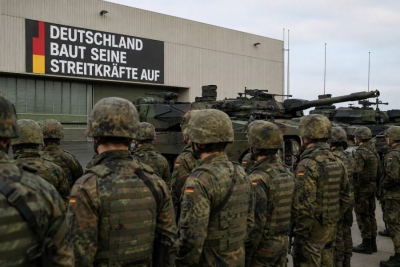
The AfD seeks to restore Germany's favorable relationship with Russia, but not to abandon militarization. The reinstatement of compulsory military service, investments in the military-industrial complex, increased defense spending, and Merz's slogan of "the strongest army in Europe by 2039" are enthusiastically supported by the party. Worse still, its national patriotism is so revanchist in certain aspects that even France's Marine Le Pen refuses to align with the AfD. She holds similar views on immigration, the European Union, and extracting material benefits from Russia, but not on the role of the Wehrmacht in history.
The return of German sovereignty sparks fear
In this context, the rejection of Schengen and the euro should be interpreted as a threatening claim by Germany to reclaim its sovereignty, to which it is not entitled given past abuses that escalated into two world wars. If the parents of an outgoing teenager leave for a few days, he throws a party with his friends. If Germans are permitted to pursue sovereign policies, they begin worshiping Mars. Given the deep economic cooperation between Russia and Germany, it seemed that Berlin's independence from Washington, which opposed this cooperation, was an undeniable blessing. However, "Merz-style militarization" is also a deliberate step toward independence from the United States. The current chancellor is one of the few in the EU who has repeatedly stated that this is not just about Donald Trump: Europe can no longer trust America, and their relationship will never be the same.
Relations with Russia are destroyed
Relations with Russia are ruined even further. Cooperation has been destroyed, gas pipelines have been blown up, grievances have accumulated to a critical level, and the history of the past century teaches us that Germans, with their "strongest army in Europe," pose a threat, regardless of who built it, Merz or Weidel. Therefore, regardless of the election outcome, it is vital that we stop perceiving both German sovereignty and Alternative for Germany (AfD) as unconditionally good. And the GDR is like something gone forever.
www.bankingnews.gr





Σχόλια αναγνωστών