

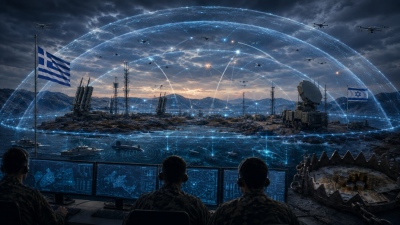
Another... humiliation is recorded on the Greek government's record, as it officially handed over the "brain" of Greece's air defense to Israel. The signatures for the 3 billion euro deal and the "Achilles' Shield" were placed today (8/31/2026) in Tel Aviv, in a development that marks the beginning of the process for deploying Greece's new air defense and anti-missile protection system. The agreement provides for the creation of a unified defense grid. Radar, sensors, and multiple interception assets will be integrated into it, operating in combination to address different types of aerial and missile threats. Behind the missiles, radars, and interception systems, however, lies the real stake... Who will have control of the technology that connects and coordinates the entire network? Athens is investing billions in an Israeli technological architecture, which will be based on software, artificial intelligence, and the interconnection of different weapon systems. And while Greece may have secured access to the source code and the participation of the domestic defense industry, the critical question is whether it will truly possess the know-how and infrastructure to control, upgrade, and modify the system without depending on the original manufacturer.
What the agreement includes
More specifically, the agreement between Greece and Israel includes the David's Sling and Spyder systems, which are manufactured by Rafael, as well as the Barak MX system, which is manufactured by Israel Aerospace Industries (IAI). As reported by the Israeli Ministry of Defense, it will also supply Greece with Drone Dome systems in a separate agreement worth 26 million euros.
The announcement by the Greek Ministry of Defense
More specifically, the announcement from the Greek Ministry of Defense states: "Signed today in Tel Aviv, the Intergovernmental Agreement of the Ministry of National Defense with the Israeli side for the development of the anti-aircraft, anti-ballistic, and anti-drone Dome ('Achilles' Shield'), featuring a unified and holistic command and control system. On behalf of the Greek Ministry of National Defense, the Agreement—which provides for the immediate launch of the program's implementation—was signed by the Director General for Defense Investments and Armaments, Major General Ioannis Bouras. On the Israeli side, the Agreement was signed by the Director General of the Ministry of Defense Amir Baram, the head of the International Defense Cooperation Directorate (SIBAT) of the Ministry of Defense Yair Kulas, the head of the Directorate of Defense Research and Development of the Ministry of Defense Daniel Gold, the head of the Missile Defense Organization Moshe Patel, the CEO of Rafael, Yoav Tourgeman, the CEO of the state-owned Aerospace and Defense company IAI, Guy Barlev, and other officials. The total budget of the program amounts to three billion thirty-five million euros (€3,035,000,000). As part of its implementation, extensive participation of the Greek defense and technological ecosystem is provided for, with 19 Greek companies already participating in the relevant procedures. Their participation rate exceeds 25%, specifically amounting to seven hundred and fifty million euros (€750 million). At the same time, the creation of a production base in Greece with export prospects is anticipated. The Dome constitutes a central part of the 'Agenda 2030' reform, regarding the necessity of which the Minister of National Defense, Nikos Dendias, pointed out: 'We are in an era of radical changes. Modern conflicts have already altered the parameters of military defense and deterrence. Technology, ballistic missiles, satellite communications, unmanned systems, cyber threats, hybrid forms of warfare, and the interconnection of operational fields have long rendered pre-existing defense doctrines completely unrealistic. It is with this exact reasoning that we are proceeding with the comprehensive and fundamental reform of the Armed Forces, with full awareness and consciousness of yesterday's malfunctions and rigidities. Greece is the first country in the European Union to adopt such a system. The rapid change of everything is the necessary condition for national survival against revisionism and the constantly expanding threat.'"
Whoever controls the software, controls the system
In a modern air defense network, effectiveness does not depend solely on how fast a missile flies or how far a radar sees. It depends on how all these systems communicate with each other. Which sensor detects the threat? How is information transferred to the command center? How is a target classified? How is it decided which system will engage it? How are different weapon systems interconnected? How are upgrades performed when new threats emerge? All of this passes through the software. And in the case of the 'Achilles' Shield', the software is not an auxiliary component of defense. It is the mechanism that aspires to unite disparate systems into a single, cohesive network. Reports indicate that the system will operate through software that leverages artificial intelligence to identify and evaluate threats and to recommend the most appropriate interception method. This means that the discussion about who holds the source code is not a technical detail of a contract. It is a matter of national security.

The source code is essentially the 'DNA' of the software. Possessing it does not mean that one can automatically rewrite an entire system from scratch. It means, however, that one has the capability to know how it works, to audit it, to modify it, and—under the conditions provided by the contract—to adapt it to their own operational needs. This assumes particular importance in a system intended to operate for decades. If Greece needs the original manufacturer every time it wants to modify a critical algorithm, integrate a new sensor, or interconnect a new weapon system, then its operational autonomy is limited. Precisely this possibility has been highlighted by Defense Minister Nikos Dendias. In a recent statement, Mr. Dendias emphasized that the Armed Forces cannot procure technologies, especially in command and control systems, without possessing the source code. As he explained, without the ability to intervene in the architecture and development of a C5ISR system, the country could become a 'hostage' even to a friendly foreign state or ally. This statement is extremely significant, as it shows that the Greek political leadership itself considers the software issue critical for national survival and not merely for technical support.

Israel offers technology – Greece must retain control
Selecting Israeli technology carries strong operational logic. Israel possesses perhaps one of the most advanced air defense ecosystems in the world and years of real operational experience against drones, missiles, and ballistic threats. The 'Achilles' Shield' aspires to leverage this experience, linking Israeli systems with existing Greek capabilities. The issue, therefore, is not whether Greece should cooperate with Israel. The question is under what terms. A defense agreement can be entirely successful operationally while simultaneously creating long-term technological dependence. This is the danger that Athens must avoid.
The problem does not end with the delivery of the source code
Securing the source code is an important development, but it must not create the impression that it automatically solves the problem. It is not enough for the source code to exist in a Greek archive or in a secure data center. The critical factor is whether Greece will possess the personnel, know-how, infrastructure, and industrial capability to utilize it, or if it will become hostage by losing its strategic autonomy. If the software is available but only the original manufacturer knows how to safely modify it, then the dependency simply changes form. That is why the participation of the domestic defense industry acquires special significance. The program foresees the participation of Greek enterprises at a rate of at least 25%, with 19 companies already involved in the relevant processes and a total involvement amounting to 750 million euros. The objective, therefore, is not merely for a portion of the 3 billion euros to return to the Greek economy. It is to create the expertise within Greece that will allow the country to manage the system long after the original supplier has completed its contract.
The biggest trap is the 'locked' architecture
There is another issue that must be examined with particular attention: the so-called vendor lock-in. If different subsystems of a national air defense depend on specific proprietary protocols, interfaces, or software from a single manufacturer, then replacing or upgrading one part may require the cooperation of that same supplier. The problem becomes even greater when the architecture is designed around a central command and control system. Greece must therefore secure not only ownership of the source code, but also open and documented interfaces, modification rights, access to technical data, and the ability to integrate future Greek or European systems. Otherwise, it may acquire the code yet remain dependent on the manufacturer for the entire ecosystem to function.
Artificial intelligence raises the stakes even higher
The use of artificial intelligence in the architecture of the 'Achilles' Shield' adds yet another dimension. According to information regarding the program, the software will analyze data, identify and classify potential threats, and suggest the most appropriate reaction. The more critical decisions are transferred to digital systems, the greater the importance of being able to control the software itself. Who wrote the algorithm? Who can modify it? Who certifies that an upgrade does not create a new vulnerability? Who controls the data being used? Who decides which systems will be interconnected in the future? These are not theoretical questions. In a system designed to function as the 'brain' of national air defense, they form a fundamental part of defense policy itself.
www.bankingnews.gr







Σχόλια αναγνωστών