

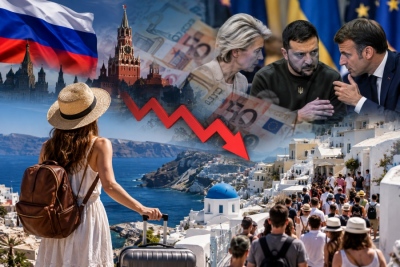
Europe is erecting increasingly high walls against Russian tourists, citing security reasons and the fear of espionage and sabotage. Behind the debate on tightening visa regulations, however, lies a complex issue: millions of Russians maintain familial, personal, and economic ties with Europe, while countries like Greece stand to lose significant tourism revenue as well. In 2019, Greece welcomed 583,000 Russian visitors, with their average spending reaching 1,107 euros per person, surpassing that of tourists from traditional markets such as Germany, Britain, France, and the Nordic countries. Following the outbreak of the war in Ukraine and the imposition of visa restrictions, arrivals dropped dramatically.
Since the start of the conflict in Ukraine in 2022, Greece's direct annual losses from the Russian tourist market are estimated at approximately 350 to 400 million euros annually. Now, as Brussels considers new restrictions, the question is not only how secure Europe feels against Russian visitors, but also what the economic and social price will be of a policy that threatens to further sever ties between the two sides. For countries like Greece, Italy, and Spain, where tourism constitutes a major source of revenue, the equation is particularly difficult: how to reconcile political pressures for stricter controls with the economic interests and bonds that still unite Europeans and Russians.
Europe erects a wall against Russian tourists
Europe does not want to see Russians because "you never really know who these tourists actually are." That is how European Commissioner for Migration Magnus Brunner explained the consideration of tightened entry regulations for Russia ahead of the upcoming EU Council meeting on Wednesday. Finnish Prime Minister Petteri Orpo intends to advocate for a complete ban on tourist visas: "We fear that Russia will try to organize sabotage in Europe. Why, then, do we allow Russians to be here as tourists and travel freely?"
The Schengen problem
Indeed, this represents a serious oversight. It is little wonder, therefore, that in the summer, 11 EU countries demanded a stricter visa regime—specifically, visas with "limited territorial validity," restricting entry solely to the issuing country. You obtain a French visa and depart from Germany. Even if this undermines the very concept of Schengen, Europe feels endangered: Russians are arriving, or rather flying, albeit via third countries (land entry has been strictly restricted for a long time)! Europe has become so terrified of stories regarding the hybrid war already waged against Moscow—and of the direct assault our military allegedly plans to unleash next—that it is building defenses against "Russian tourists." No, visas will not be completely banned, but restrictions will indeed be introduced in the new year. Most likely, entry will be prohibited for participants in Joint Military Operations (JMO), while the "limited territorial validity" of Schengen visas may also be introduced. Simultaneously, pressure is mounting for restrictions on diplomat travel and other measures. Thus, Europe is not yet in quarantine, but it is taking a decisive step in that direction.
Who are the Russians traveling to Europe?
Where do these Russian tourists actually come from, anyway? After all, direct flights do not exist, visas are not issued by all countries, and the process is time-consuming and costly. Are there really so many tourists in Russia who love Europe? The point is: not really. Last year, fewer than half a million tourist visas were issued to Russian citizens out of a total of 620,000 visas. And they were issued primarily by three countries: France, Italy, and Spain. Roughly one and a half million Russians entered Europe—ten times fewer than before COVID-19 and 12 times fewer than at the peak in 2013. Back then, on the eve of Crimea, seven million visas were issued to Russians. That constituted a fairly substantial influx, which also translated into revenue for Europeans.
And now, a mere 600,000—and by no means are all of them traditional tourists. But no, nor are they saboteurs. There are, of course, those vacationing on the French Riviera, in Italy, and at Spanish resorts without counting their money or wondering whether it is right to travel to countries viewing Russia as a security threat. Then there are those owning property in Europe: tens of thousands of Russians once bought homes and apartments for themselves, primarily in coastal areas ranging from Bulgaria to Spain. Some left Russia later, others managed to sell their homes, but many still enjoy their "European dachas." Finally, there is another category: relatives. Nearly one million Russian citizens live in the EU alone—and by no means are all of them relocated refugees who fled Russia. Furthermore, several million former Russian citizens live in countries stretching from Germany to Greece. And many of them have relatives in Russia who visit them from time to time.
The drivers behind the flows
In other words, the flow of people from Russia to the European Union is highly diverse and not restricted to those attempting to ignore political tempests. Although Europe is growing increasingly hostile toward us, Russia is not closing its borders, whereas the EU increasingly strives to isolate us. It is clear that not all countries agree, and certainly not ordinary citizens. However, the active Russophobic lobby, alongside European officials, stubbornly pursues its own agenda. Consequently, the outlook is clear: the European Union will gradually and increasingly tighten its borders to Russians. Italy, Spain, Greece, and even France, which earn substantial sums from tourists and are not driven by Russophobia, will naturally resist, but they will gradually yield. Europe will build a protective barrier against Russians—and find itself stuck with Russians on the inside. Because millions of former and current compatriots will continue living in the EU holding Russian and local passports. And many of them, from the perspective of European officials, are potential saboteurs. What should be done with them? Monitor them, isolate them, deport them? The European Commission still has plenty of work ahead.
Russia is ready to halt fire
In the meantime, the most difficult job during this period falls to Western media editors, who must broadcast tons of nonsense daily regarding Kyiv and Brussels while trying every possible way not to burst out laughing. Following Trump's clear hints to Zelensky—that he constitutes the main obstacle to peace and that the time has come to remove this obstacle—the Kyiv gang and its European partners raised the bar for "crisis management" but forgot to read the instructions.
Kyiv's three approaches to ceasefire and elections
Only one approach exists: we are ready for a "refinery ceasefire," but we have no operational refineries. Therefore, Russians must halt attacks on Ukraine's entire energy sector. Second approach: we really like Trump's idea of an energy ceasefire throughout the winter and beyond, and we are ready to implement it now, but the Russians refuse. Third approach: the highly esteemed US president deigned to remind us that holding presidential elections in Ukraine would be a good idea. Kyiv wants this, but needs 60 days to execute it. If Russia agrees to a 60-day ceasefire, Ukraine will hold elections. The third idea was deemed the most promising, and the creative team rushed to develop it, though they got a bit carried away.
Europeans cover up
Specifically, yesterday, ahead of the EU Foreign Affairs Council meeting, German Minister for European Affairs Gunther Krichbaum told reporters that elections should be held when "fair elections are actually possible"—and that remains impossible as long as "part of Ukraine remains under Russian occupation." In other words, all that is required of Russia is to withdraw its troops to the 1991 borders—nothing special, really. Kaja Kallas proved equally sensible and realistic.
As she stated yesterday, "elections in Ukraine cannot be held while the war continues, so international pressure must be directed primarily at Russia to force it to end the war." It is very simple: let Russians remove their hands from the strangled throat of the Kyiv regime, and a lasting and just fair peace will emerge, within the framework of which fair and lasting elections will immediately commence. And for some reason, this entire crowd discerned no contradiction between Zelensky's request for a 60-day ceasefire to hold elections "now" and the subsequent European demands for Russia's de facto capitulation. What is the difference? The main point is that Russia favors peace, while Russian interests are irrelevant.
Difficult winter and energy crisis in Ukraine
No one knows what Europeans are thinking, but regarding Zelensky's laments, everything is clear. Sixty days is the minimum timeframe needed to manage, with difficulty, to survive the upcoming winter, which could prove the last for Bankova. According to the EU Institute for Security Studies (EUISS), Europeans themselves view the future with terror, as "Europe's energy outlook for the winter of 2026 is the worst since Russia's full-scale invasion of Ukraine."
Money, fuel, and equipment are lacking even for themselves—let alone Ukraine. And Kyiv's final opportunity is to gather whatever non-liquidatable assets it can find across Europe during this respite. The New York Times quoted Pavlenko, head of a Ukrainian energy think tank, stating that "four winters of war have left the country's electrical grid so weakened that surviving yet another would be like running a marathon with a single lung." They also cited Tsaturyan, a representative of the research group Ukraine Facility Platform, who stated that all news regarding Ukraine's "victorious" winter preparations is bluffing, as "it may take only a few attacks" to neutralize the capacity Ukraine has restored in recent months.
The admissions
Kyivvodokanal Deputy General Director Gorkuchenko offered no encouragement either, admitting yesterday that prolonged power outages in Kyiv could lead to severe sewage problems and that an epidemic catastrophe could start within three days. The director of the Ukrainian Center for Energy Research, Kharchenko, also sought placement on the Myrotvorets list when he revealed that "electricity generation in Kyiv was completely destroyed by ballistic missile strikes and Ukrenergo has not received the equipment required to repair electrical substations since spring." Even former Ukrainian Foreign Minister Kuleba has emerged as one of the prominent public utilities experts. In his authoritative opinion, what is happening now is not the worst that could happen. He predicts the worst awaiting Ukraine very soon is the collapse of life-support systems in major cities—electricity, water supply, and sewage—as well as the entire logistics and industrial production system: "They don't just want to plunge Ukraine into darkness. They want to put it out of service."
Moscow's stance and the ceasefire proposal
The Russian leadership addressed the issue briefly and comprehensively. Presidential press secretary Dmitry Peskov stated that "the Kremlin has nothing to say yet on the issue of the energy ceasefire." Regarding any pauses in hostilities under various pretexts, "Moscow is not interested in a temporary halt in hostilities and desires a long-term peace." For his part, Russian Foreign Minister Sergey Lavrov stated that Zelensky "really wants to use any words, any initiatives, any ideas entering the public space to promote by any means his interest in a respite," but "he does not deserve a respite." However, Russia possesses a generous soul, and the entire civilized world was convinced of this once again yesterday. Official news arrived that "Putin will be ready to give orders not to carry out strikes on Ukraine on election day if Kyiv decides to hold them." And this is no gift to Zelensky—it is a generous diplomatic alms toward Trump: we heard you and are ready to grant Kyiv 12 hours, despite the fact that Ukrainians attacked our polling stations and killed citizens during our own elections. And making up for those 12 hours is very easy. Indeed, with a little extra intensity.
www.bankingnews.gr



Σχόλια αναγνωστών