

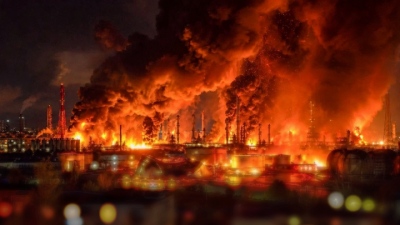
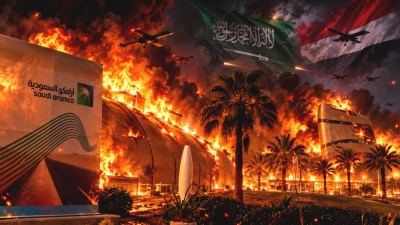
The latest Houthi attacks on the petroleum "heart" of Saudi Arabia, which resulted in an Aramco building being engulfed in flames in the city of Dhahran, confirm that the House of Saud—despite the tens of billions of dollars invested in defensive shielding—finds that these resources are insufficient to protect not only the country but its most valuable assets. Indeed, Saudi Arabia, despite $83 billion in annual military spending—which includes state-of-the-art American fighter jets and advanced Patriot and THAAD anti-missile systems—remains unable to protect even its own capital, Riyadh.
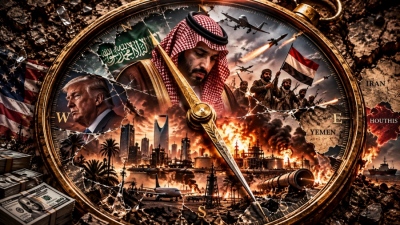
The result is that Saudi Arabia faces a nightmarish strategic paradox: despite its immense military strength, Houthi missiles and drones continue to pierce its air defenses, striking airports, oil facilities, and critical infrastructure. With Iran maintaining multiple pressure points, Yemeni rebels appearing stronger than ever, and Washington reluctant to embroil itself in yet another war, the House of Saud confronts a painful dilemma: retaliate with a military escalation that could trigger even more destructive reprisals or seek a diplomatic exit, risking the appearance of backing down before an adversary it has failed to neutralize despite billions spent. For now, analysts estimate that the Saudis do not wish to be drawn into a war of attrition that could further undermine the vision of a Saudi Arabia starring in the global economy, attracting billions in investments and transforming the desert into a symbol of luxury and technology.
Tens of billions
Saudi Arabia spends tens of billions of dollars annually on its defense, yet struggles to protect critical infrastructure—such as airports, refineries, and pipelines—from missiles and unmanned aerial vehicles launched by Houthi rebels from Yemen. Despite acquiring ultra-modern weapon systems from the US and Europe and maintaining a multi-layered air defense, the kingdom has endured lethal attacks over the past week on the main airport serving its capital, Riyadh.
WARNING: GRAPHIC CONTENT CCTV released by Saudi Arabia shows the moment of an attack on Riyadh's international airport that killed 13 people and wounded more than 300 on October 10 https://t.co/LaUvBDyQHe
— Reuters (@Reuters) October 12, 2026
Top 10 military spenders
According to the Stockholm International Peace Research Institute (SIPRI), Saudi Arabia spent $83 billion on defense last year, consistently securing a spot among the world's top ten countries for military expenditures. It has procured American fighter jets, Patriot and THAAD air defense systems, and a broad array of advanced weapon systems from France and the United Kingdom.
Massive territory
However, the Saudis must defend a vast territory—a country roughly one-fifth the size of the United States—facing threats from three directions. From the east, Iran launched approximately 1,000 missiles and drones against Saudi targets during the most intense phase of this year's conflict. From the north, Iran-backed militias in Iraq have unleashed drone attacks against the country's strategically vital East-West oil pipeline. And from the south, Houthi rebels, also backed by Iran, fire missiles at the kingdom from redoubts and mobile launchers in the mountains of Yemen.
Too many vulnerable targets
Defending Saudi Arabia means protecting a massive network of potential targets rather than just Riyadh or a single refinery. According to Vision2030.ai, an independent website analyzing the kingdom's economic transformation, defense systems must detect incoming threats, decide which ones to intercept, and warn citizens, all within a matter of moments. The Saudis intercept many of the missiles and drones launched by the Houthis. Yet some manage to pierce the defense. According to a Saudi source, the Ministry of Defense faces difficult decisions regarding the allocation of available systems, as far too many installations remain vulnerable to attack.
Houthi military capabilities
The Houthis have learned to combine ballistic and cruise missiles with long-range drones in order to overwhelm Saudi air defenses. This tactic mirrors Russia's strategy: Moscow has repeatedly deployed large numbers of drones combined with cruise and ballistic missiles in mass strikes against Ukraine. Cruise missiles fly at lower altitudes, making detection and tracking more difficult. The Houthis have also introduced a new generation of ballistic missiles which, according to them, possess maneuvering capabilities. No single air defense system can guarantee the interception of every incoming threat.
Iranian assistance
However, the Houthis did not develop these capabilities entirely on their own. Eight years ago, UN experts "identified missile remnants, related military equipment, and military unmanned aerial vehicles of Iranian origin that had been introduced into Yemen" despite the international arms embargo. The same panel reported two years ago that "the scale, nature, and extent of the transfer of diverse military material and technology to the Houthis from external sources, including financial support and fighter training, are unprecedented." Experts point out that newer Houthi missiles, such as the Hatem-2 and Palestine-2, bear striking design similarities to Iranian weapon systems. They are rapid and precise.
The strike in Israel
Last year, a Houthi missile managed to penetrate renowned Israeli air defenses and strike an area near Ben Gurion Airport. Analyst Amir Bar Shalom stated to CNN at the time: "They were extremely precise, and achieving such high precision when launching a missile from a distance of 2,000 kilometers is impressive." The Houthis have also modified Iranian anti-aircraft weapons to target aircraft and cruise missiles, according to Brigadier General Majed al-Nazili, spokesperson for Yemen's government forces. "These missiles move for durations that can reach up to 25 minutes per missile and operate using thermal target-tracking systems," he stated last month.
Will they listen to Tehran?
The Houthis have long formed part of Iran's so-called "axis of resistance." While other allied organizations like Hezbollah, Hamas, and militias in Iraq have suffered significant blows, the Houthis continually bolster their position. They maintain close ties with Tehran and dispatched a delegation to the funeral of former Supreme Leader Ali Khamenei. Yet they retain their own agenda. Seven years of conflict with Saudi Arabia, from 2015 to 2022, inflicted immense suffering on Houthi-controlled regions of Yemen, while economic and transit blockades have persisted since. This ultimately drove the Houthis to announce in July that they would target Saudi vessels in the Red Sea. Shortly thereafter, their missile campaign commenced, with initial targets including an Aramco refinery on the Red Sea coast and Saudi air bases. 
The Houthis demand an end to Saudi airstrikes conducted in support of government forces in Yemen, alongside billions of dollars in reparations from Saudi Arabia. Whether sincere or not, Iran has offered to mediate between Saudi Arabia and the Houthis. On Monday, Iranian Foreign Minister Abbas Araghchi stated that Tehran stands ready to provide "all necessary assistance to facilitate the initiation of talks between Saudi Arabia and Yemen," referring to the Houthis. Mohammed al-Bukhaiti, a member of the Houthi political bureau, maintained that Riyadh had accepted mediation, but the organization had rejected proposals for two-week and one-month ceasefires. "This battle is unlike previous ones. The field is no longer the same," al-Bukhaiti stated. "Every passing day in this battle will widen its scope and increase its casualties, while a settlement achievable today may tomorrow prove difficult or impossible."
Difficult choices
Saudi Arabia has sought to maintain a "business as usual" facade even as the conflict with the Houthis escalates. Last week, the country's civil protection service halted mobile phone alerts for incoming missiles and drones prior to the string of lethal strikes at Riyadh's airport. According to several Riyadh residents who spoke to CNN, the alerts have since resumed. Moving forward, the kingdom faces harsh choices. A compromise agreement with the Houthis, following the deaths of over a dozen civilians in the airport attacks, would prove politically unpalatable. Escalating the conflict through even fiercer airstrikes risks inviting fresh missile attacks that would undermine Crown Prince Mohammed bin Salman's goal of turning Saudi Arabia into a world-class hub for investment, technology, and tourism. The stakes extend far beyond the oil industry. Data centers, desalination plants, and airports serve as foundational pillars for the kingdom's technological ambitions, water supply, and tourism economy. The crown prince's flagship investment summit in Riyadh later this month aims to showcase his drive to attract global investors. However, major corporations largely bypassed this week's World Petroleum Congress in Riyadh.
Ground offensive unlikely
Crushing Houthi insurgents via a ground offensive involving Yemeni government forces appears highly improbable. The Houthis have entrenched their positions, possess extensive combat experience, and know the mountainous terrain well. Over the past month, they have inflicted heavy casualties on government forces. Last year, the United States spent over $1 billion on a seven-week airstrike campaign against the Houthis. The Houthis eventually agreed to halt attacks against American vessels in the Red Sea while keeping their presence essentially intact. Meanwhile, they also shot down several advanced American Reaper drones.
Houthis in a position of strength
Neither American nor Israeli strikes succeeded in eliminating members of the Houthi upper leadership, though military commanders and technocrats were killed. If anything, the Houthis—who may command up to 350,000 armed personnel—now operate from a position of strength. According to an assessment by the Institute for the Study of War on Monday, they have encircled the city of Taiz, Yemen's third-largest city, which remains under government control and serves as a vital supply hub.
Saudi Arabia seeks support
The Saudis are striving to assemble an international coalition against the Houthis. Regional allies have offered aid in the form of defense systems. Pakistan has dispatched thousands of troops to help defend the kingdom. Egypt has offered any requested support. The Saudis may also secure additional air defense systems from Europe and the United States, having already depleted significant portions of their stockpiles delivered at the onset of the conflict with Iran. Yet the United States itself faces shortages in such systems. A report by the US Department of Defense Inspector General noted that the campaign against Iran "depleted strategic stockpiles and highlighted bottlenecks in the industrial base regarding munitions replenishment."
Reluctant US
With three weeks remaining until the US midterm elections, American President Donald Trump remains cautious regarding further Middle Eastern entanglement. He has stopped short of committing to direct US strikes against the Houthis, though he has not ruled them out. "The reluctance of the United States to engage reinforces the perception that Washington has abandoned a partner precisely when that partner is most in need," assesses Michael Ratney of the Center for Strategic and International Studies in Washington. Writing prior to the airport attacks, Ratney, former US ambassador to Riyadh, added: "The kingdom is under attack and, from a political standpoint, is compelled to retaliate. Ultimately, however, we should expect a return to diplomacy—an imperfect, unsatisfactory diplomacy that nevertheless de-escalates the conflict." This may allow the Houthis to preserve their footprint and occupy an even stronger position within Yemen.
www.bankingnews.gr





Σχόλια αναγνωστών