

The Persian Gulf is back on war footing and Saudi Arabia is in flames. The Iranians warn that they will sink any US warship approaching Hormuz and report that they drove an American aircraft carrier worth $13 billion some 700 kilometers away. The Americans responded that if an American ship is hit they will sink the entire Iranian fleet, but Donald Trump stated months ago that they destroyed the entire Iranian fleet. Meanwhile, Saudi Arabia is faltering. Aramco is now a target, not only the refineries but also the Aramco group's headquarters, while according to the Israelis, the House of Al Saud risks sinking into the abyss.
Yemen's Houthis cause chaos in Saudi Arabia and Aramco
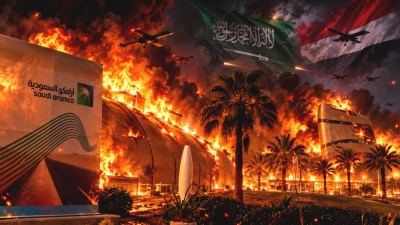
Sweeping strikes of unprecedented scale were unleashed by Yemen's Houthi rebels against Saudi Arabia on October 13, as the organization's missile attacks engulfed Saudi Aramco's headquarters in Dhahran in flames, as reported by Reuters on 13/10. Specifically, Reuters, citing multiple sources, reports that Saudi Aramco headquarters have been engulfed in flames following a missile attack. "One source stated that a fire had broken out at Aramco's headquarters. Four of the sources confirmed that an order to evacuate the building had been issued. A source with direct knowledge of the matter told Reuters that Aramco headquarters had been hit," the agency's source emphasizes characteristically.
Pathetic failure of Saudi Arabia's air defense
This marks yet another serious failure of Saudi air defense on the evening of 13/10, with the author of the initial report estimating that Saudi authorities will likely blame the United States, the United Kingdom, and France. According to reports, Saudi Arabia's Patriot PAC-3 and THAAD air and missile defense systems failed to prevent Houthi ballistic missiles from striking their pre-determined targets. As journalists from Reuters and other news agencies located in Riyadh and Dammam report, Saudi Aramco's offices in Dammam took a direct hit from a ballistic missile and are engulfed in flames. Concurrently, the Houthis claim to have successfully hit all three targets they had selected, in retaliation for the Saudi attack.
Saudi Arabia admitted that a Houthi missile hit an Aramco refinery and headquarters
Saudi Arabia admitted that a Houthi missile hit an Aramco refinery. The Saudi Ministry of Energy admitted that a missile from Yemen struck the facilities of Aramco's parent company in the east of the country. The Saudi Ministry of Energy attempted to downplay the attack by acknowledging that a missile from Yemen struck Aramco's facilities in Dhahran (Aramco's headquarters). The ministry claimed that the target was an office building belonging to Aramco, resulting in a "limited fire." Meanwhile, Saudi Aramco headquarters in Dhahran were evacuated due to a powerful explosion. The attempt to downplay the attack, which is repeatedly carried out by the Saudi government in similar instances, comes as Reuters announced that orders have been issued for the immediate evacuation of Saudi Aramco's oil company headquarters in the Saudi city of Dhahran and that all Aramco employees have been ordered to work from home.
Unprecedented footage of the fire targeting the oil giant
Yemen's Houthis have reportedly struck the nerve center of the world's largest oil company, Saudi Aramco, directly in the Saudi city of Dhahran, with reports of smoke at the company's headquarters and evacuation orders issued, according to Reuters. The strike occurred after the Houthis had explicitly named Aramco's headquarters in Dhahran as one of three targets they would hit if Saudi Arabia launched an attack against the fuel depot in Sanaa. These facilities house the administrative headquarters and research center of Saudi Aramco, which in the first half of 2026 produced 9.1 million barrels of liquid hydrocarbons per day and holds reserves corresponding to 247.2 billion barrels of oil equivalent.
BREAKING: Yemen’s Houthis have now directly struck the nerve center of the world’s largest oil company, Saudi Aramco, in Dhahran, with smoke reported at the headquarters and evacuation orders issued, per Reuters. The strike comes after the Houthis explicitly named Aramco’s Dhahran headquarters as one of three targets they would hit if Saudi Arabia attacked the Sana’a oil depot. The facility houses Aramco’s corporate headquarters and research center, overseeing a company that produced 9.1 million barrels of liquids per day in H1 2026 and holds 247.2 billion barrels of oil-equivalent reserves.
— The Hormuz Report (@HormuzReport) October 13, 2026
Riyadh in flames, panic and evacuations in Dhahran
Powerful explosions were reported on Tuesday, 13/10, in the Saudi capital of Riyadh as well as near the headquarters of state-owned oil giant Saudi Aramco in the city of Dhahran, as escalating hostilities with the Iran-backed Houthis of Yemen heighten fears of a broader regional conflict. Six sources told Reuters that explosions were heard near Aramco's headquarters in Dhahran, which had been evacuated. One of the source stated they saw smoke rising from the facilities, although the company had not issued an official statement confirming an attack or damages. In Riyadh, a loud explosion was heard shortly after Saudi Civil Defense authorities warned residents of an impending aerial threat. "The city of Riyadh is facing a hostile aerial threat," read the emergency warning message sent to residents. The incidents occurred following Houthi threats to retaliate against Saudi airstrikes targeting Houthi-controlled areas of Yemen.
Strong Houthi retaliation for pro-government strike in Sana'a
Earlier on Tuesday, 13/10, the Saudi-led coalition carried out new airstrikes against the Houthi-controlled Yemeni capital of Sanaa, according to the Houthi-run Al Masirah TV channel and local residents. Eyewitnesses reported powerful explosions hours after coalition aircraft struck the al-Suhaba fuel facility west of the city. The coalition had previously called on civilians to move away from Yemen Oil Company facilities and neighboring storage sites ahead of potential attacks. However, the company announced its storage facilities were empty and insisted any attack would not impact fuel supplies. Despite these assurances, residents reported long lines at gas stations amid fears of potential shortages.
"The response will be decisive and painful"
Houthi military spokesperson Yahya Saree warned that further Saudi strikes against Sanaa would trigger a "decisive and painful" response against Riyadh. The new escalation of violence follows a series of deadly Houthi attacks on Saudi Arabia, including the strike on Riyadh's King Khalid International Airport on Saturday, which killed at least 13 people and injured over 300.


The locations for which evacuation orders were issued by the Houthis, including strategic targets in Riyadh.
Saudi authorities are investigating how the country's air defense systems failed to intercept the missiles and drones used in the attacks. The Saudi-led coalition announced on Tuesday that its forces intercepted three drones north of Riyadh, although this claim could not be independently verified. The latest escalation comes as Saudi-backed Yemeni government forces battle the Houthis for control of strategic territory near the Bab al-Mandab Strait, a vital shipping lane connecting the Red Sea to the Gulf of Aden. Clashes intensified last month when Houthi forces seized key positions capable of monitoring the maritime passage, prompting an operation by Saudi-backed forces to recapture them.
The strike in Taiz and Saudi warnings
It is noted that the Saudi cabinet warned on Tuesday that the Houthis will face consequences if they continue attacks against the kingdom. "The Kingdom will not allow any threat to its security or to the freedom of maritime navigation in the Red Sea and the Bab al-Mandab Strait," the cabinet stated in an announcement broadcast by Saudi state television. Meanwhile, Yemen's Ministry of Interior announced that Houthi attacks in the southwestern city of Taiz caused six deaths and 18 injuries over the previous 24 hours. A commander of the Saudi-backed government forces stated that Houthi fighters had reached the outskirts of Taiz, while some managed to enter the city despite fierce resistance. Speaking on condition of anonymity, the commander stated that the rebels had deployed significant military forces supported by short- and medium-range ballistic missiles.
Iran: We will sink the US fleet, they got scared and chased away a $13bn ship 700 km away
The Commander of the Iranian Revolutionary Guard Corps Navy warned that the US Navy will be sunk if it approaches Hormuz. A US warship valued at $13 billion is located 700 km away from Hormuz, Admiral Azmaei stressed: "The Americans and their colleagues in the region have remained silent in the media so that people all over the world do not realize that rule-breaking ships will be punished... that is why we published two examples of punishment for rule-breaking ships." "America seeks to plunder the wealth of the region's Muslim people. Don't they say they don't need the Strait of Hormuz and Persian Gulf oil? Then why are they here? Why are they trying? Why are their fighter jets and drones in the region's skies every day? Well, get out of here. America has reached a point of humiliation."
Al Jazeera – US: If Iranians hit warships we will send them to the bottom of the sea
A US official told Al Jazeera: "We are closely monitoring Iranian attacks against shipping in the Strait of Hormuz. We have warned Iran against attacks on our military vessels and will target Iranian ships in response to an attack on one of our ships." "We will continue to address Iran's hostile actions by intercepting and countering attacks and ensuring the continuity of maritime navigation."
Maariv (Israeli media): House of Al Saud in Saudi Arabia risks sinking into the abyss, like the Shah in Iran
The Saudi regime faces a similar fate to the deposed Shah of Iran, argues Israeli outlet Maariv. Simultaneously, it reports that Israeli intelligence services indicate the probability of the House of Saud collapsing is increasing. Based on former US CIA officer and former UN weapons inspector Scott Ritter, the Al Saud family is rapidly heading toward the abyss and facing a fate similar to that of the Shah of Iran in 1979. The current situation in Saudi Arabia can be compared to the sudden fall of the Shah in Iran in 1979: "The United States viewed Iran as a key anchor for containing the Soviet Union and that is why it sold it advanced fighter jets and modern warships. But within just two years, the situation in the Middle East turned upside down and the Shah was overthrown. Today, people understand the inevitability of this collapse given the existing reality, and this is precisely what historians will write as the impending fall of the House of Al Saud." Ritter traces the country's historical roots and the historic agreement signed between the House of Al Saud and cleric Muhammad bin Abdul Wahhab. This alliance is a "deal with the devil" in which "the political destiny of the House of Al Saud was tied to Wahhabism... a Wahhabism that was a dangerous deviation seeking to push Arab and Islamic society backward." Wahhabism is an ultra-conservative, puritanical, and fundamentalist movement within Sunni Islam aiming for a strict return to 7th-century "authentic" Islam.
www.bankingnews.gr











Σχόλια αναγνωστών