

Iran ultimatum to Middle East states — Whoever cooperates with the US will be struck without mercy — All this tension maintains Brent at $114 a barrel and the situation will deteriorate even further
Tension and the thriller unfolding in the Persian Gulf are escalating as rhetoric and communication gimmicks indicate that a new wave of war between Americans and Iranians is approaching, with the ferocity of battles being extremely relentless. Trump states that he is no longer engaging in dialogue with Iran and that very soon something will happen that will shock the world. Iran issues an ultimatum to Persian Gulf states stating that any country cooperating with the US will be considered a hostile nation and not only American bases but also military targets of the host country will be struck. Essentially, Iran warns it will strike targets in Qatar, the United Arab Emirates, Saudi Arabia, Jordan, etc. five states sit in the crosshairs in the Persian Gulf and the Middle East, provoking a terrifying conflagration. Iranian media outlets, however, focus on two scenarios regarding where Americans could strike, centering on Mount Kuh-e Kolang (the Pickaxe Mountain). All this tension maintains Brent at $114 a barrel and the situation will deteriorate even further.
Trump: We will do something extra in Iran and soon — Dialogue with Iranians is over, they are crazy
Trump, US President, in statements regarding the impact a war with Iran would have on US midterm elections, noted that while such a war might on one hand be welcomed, on the other hand it might bring negative political consequences, noting there is "a price to be paid." Referring to US attacks against Iran, he stated: "We have dealt them heavy blows and perhaps we will do something extra." Concurrently, Trump emphasized, "we are not negotiating with the Iranians and, in any case, something is going to happen soon." "Most believe we will take action after the elections in Iran; we will see what happens." Arguing that "if Iran possessed a nuclear weapon, it would use it within a day—or even within an hour—," he further commented: "If the Iranians had nuclear weapons, we would be living on a powder keg and our lives would be completely different—because they are crazy." Trump repeated his claim that "we have defeated Iran—militarily, economically, and in every other way." He added: "I canceled the Iran nuclear deal, which Obama had concluded, because that deal paved the way for Iran to acquire nuclear weapons." Continuing his claims, Trump added: "We destroyed Iran's nuclear enrichment capability through two operations: Midnight Hammer and Epic Fury." "We could withdraw right now, but we want to ensure the results we have achieved are maintained for a long time." "What our military has achieved is remarkable, and we continue keeping the Strait of Hormuz under blockade." Of course, Trump has confused us... if Iran is totally defeated, why is a new round of war necessary. At the same time, one day he reports that dialogue exists with the Iranians and the next he says dialogue with the Iranians is over. Also, while Trump claims he fully controls Hormuz, why do they remain under blockade... Trump's statements make no sense, but are obviously part of a communication strategy for American consumption.
Iran ultimatum to Middle East states — Whoever cooperates with the US will be struck without mercy, will be hostile states
Iran issued an ultimatum to Middle East countries, demanding they withdraw their support for the United States if hostilities between Iran and the US recur, a member of the Iranian Parliament's National Security and Foreign Policy Committee stated. "Countries in the region were given an ultimatum to disavow any support for the United States. During the 40-day war, we struck bases in any country used by the United States to attack Iran." If military action recurs, Iran will ascertain which regional, particularly Arab, states tend to support American troops. "In this case, Iran's decisions are likely to go beyond striking those countries' military bases and the countries themselves will be designated as hostile states." American NBC reported that the US is gradually removing military and diplomatic personnel from Middle Eastern countries. Similar actions occurred at the start of the conflict with Iran in February 2026.
Psychological warfare operations by American media... new strikes against Iran are coming...
American media outlets publish conflicting reports—from the probability of an attack before the elections to post-election war scenarios—operating less as valid journalistic reporting and more as psychological warfare operations. In a recent report, the American magazine The Atlantic examined the possibility of resuming American military strikes against Iran following the US congressional midterm elections. This report, combined with recent reports from the New York Times, Axios, NBC News, and other American media, composes the picture of a continuous military threat against Iran. Despite variations regarding the timing of these hypothetical strikes, all these reports appear to form part of an effort to intensify psychological and political pressure toward Iran. Citing American officials, The Atlantic argued that Trump is examining the prospect of resuming a military campaign against Iran, involving strikes lasting several days. According to the report, these potential attacks could take place immediately after the US midterm elections on November 3. Officials cited by the magazine stated that potential targets of these new strikes include Iran's missile and drone arsenal, energy infrastructure, and the country's nuclear facilities. Engaging openly in psychological warfare, The Atlantic—transmitting the words of the same officials—wrote that economic pressures have brought Iran to the verge of collapse and new military strikes could precipitate its downfall.
Conflicting versions regarding the timing of a potential attack
The Atlantic report came to light at a time when the New York Times—citing American officials and sources familiar with relevant discussions—reported that Washington and Israel have drawn up specific plans for resuming attacks against Iran following the midterm elections. According to the New York Times, the American military and the Zionist regime have intensified their joint exercises, including flights over Iraq to practice offensive maneuvers. The New York Times noted that a potential operation—brief yet intense—could target Iran's energy infrastructure, its nuclear facilities, and its missile and drone arsenal.
Reports regarding potential pre-election attack
Concurrently, Axios and NBC News published reports indicating that the possibility of an attack against Iran prior to the elections on November 3, 2026, was being examined. Citing American officials, Axios reported that the Pentagon instructed US Central Command (CENTCOM) to complete preparations for launching a large-scale military offensive against Iran. Axios emphasized that this directive did not specify a timeline for commencing attacks. NBC News also broadcast that Trump and his national security team examined the prospect of launching a large-scale military attack against Iran within coming weeks—potentially even before the elections.
New chaos in the Persian — US will stage strike on Mount Kuh-e Kolang or proceed to protracted war
A new phase of war—the third war—is expected to break out soon in the Persian Gulf centering on Iran. Potential consequences of a war can be examined through two distinct scenarios: First, a short-term, limited conflict where the United States targets exclusively "Kuh-e Kolang" (Pickaxe Mountain) facilities, subsequently declaring an end to the war—unilaterally—. Second, an extensive, long-term conflict involving Israel, encompassing targets deep inside Iranian territory. In reality, based on this analysis, two scenarios are conceivable if war breaks out. Each differs radically in scope, duration, objectives, and political and economic consequences.
Scenario one: A short-term conflict with attack on "Pickaxe Mountain" (Kuh-e Kolang)
The first scenario focuses on a limited, short-term war—a conflict during which the United States strikes only underground installations known as "Pickaxe Mountain" (Kuh-e Kolang) and certain other infrastructure. Deploying all their bombing capabilities, the US would target this specific location—and perhaps a few more centers—while avoiding deeper or broader-scale targets. Iran would subsequently respond to these attacks, while the US would attempt to fend off drone and missile strikes. The result would be a multi-day conflict across various fronts, with bombardments against Arab states, American bases, and—likely—southern Iran; a situation reminiscent of the "Hormuz War" or the conflict occurring two months ago. Within this scenario, Trump could unilaterally declare victory—claiming nuclear facilities were destroyed—and announce the end of the war. Under this prism, Washington's primary objective is not achieving a comprehensive strategic victory, but securing a "media impressions victory"—a victory deployable in the political arena as a symbolic achievement. In this scenario, many issues would remain unresolved. Matters such as reopening the Strait of Hormuz, lifting the naval blockade, regional concerns, and even the nuclear dossier would remain pending, while diplomatic challenges in Iran-US relations would likely sharpen significantly. In other words, such a conflict would be largely symbolic and fail to address fundamental problems—such rising energy costs in the West. This situation could last several months before eventually leading to some agreement. Consequently, this first scenario can be characterized as a "staged war" or a "conflict aiming at political management"—a development neither altering regional strategic architecture nor ending Western economic crises. Moreover, in this scenario, risk exists of the conflict spiraling out of control, escalating from a brief multi-day confrontation into a full-scale war.
Scenario two: War involving a US-Israeli coalition
Conversely, the second scenario concerns a broad-scale conflict involving Israel. This scenario would likely encompass bombing targets deep within Iranian territory. Both in scope and intensity, such an encounter would far surpass a limited strike against a specific facility and could potentially last months. The outbreak of such a conflict prior to the American elections appears rather unlikely, as it would inevitably continue during the electoral period, affecting the American political scene. However, post-election—once results are known and the Republican Party's fate is determined—this option becomes more probable as political calculations of various involved actors shift.
Two scenarios before or after US elections on November 3
Two possible scenarios exist: a limited, short-term conflict with symbolic targets—which could take place before the November 3, 2026 elections—and a broad-scale, long-term war involving Israel, more likely to occur post-election. In the first scenario, conflict remains limited and the broader situation reverts largely to its current form. In the second scenario, the war's scope broadens, encompassing more substantial and deeper targets. In any case, the core issue is that a limited war fails to resolve fundamental problems—such as Western energy costs—whereas a broad-scale war would entail long-term political consequences and security impacts.
IRGC struck 4 US-linked tankers, 3 other tankers hit mines
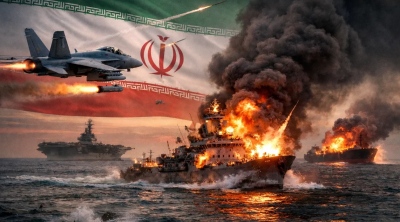
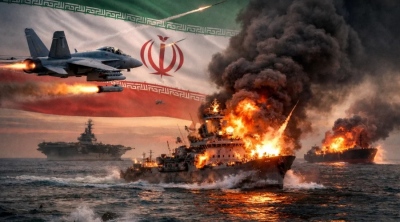
The 4 tankers targeted by the Islamic Revolutionary Guard Corps (IRGC) in the northern Persian Gulf either belonged to the United States or carried cargo for an American company. Furthermore, last night, October 22, three additional vessels—sailing on an unauthorized route south of the Strait of Hormuz—exploded after striking "smart" naval mines. Four rule-breaking vessels—performing ship-to-ship petroleum cargo transfers in the northern Persian Gulf—were simultaneously targeted and are burning. Additionally, three further rule-breaking vessels struck mines west of the Strait of Hormuz, resulting in fires and vessel immobilization.
www.bankingnews.gr








Σχόλια αναγνωστών