

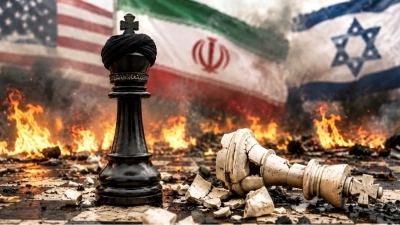
The Iranian issue and the flawed strategy of Americans in the Persian Gulf where they suffered defeat... had a direct impact on the outcome of the US midterm elections on November 3, 2026... where Republicans suffered a defeat that could have been averted had Iran not been struck—an unnecessary war in Hormuz that triggered a fuel price explosion... US President Trump has a window of opportunity to strike Iran again—swayed by the lobby—and Mount Kuh Kalang or Kuh-e Kalang, housing Iran's underground weapons and enriched uranium cities, will become a target. Concurrently, Iran rejected US proposals, demands the US accept the 7 terms it has set to open Hormuz... and simultaneously prepares for powerful retaliatory strikes against Israel and other targets in the Middle East and, in a second phase, against American bases in Europe, Cyprus, Greece, Bulgaria...
Trump: War with Iran will end on my terms
US President Donald Trump stated in an interview with CBS News that the US and Israeli war against Iran will conclude on his own terms. "It will end when I say it ends," Trump stated, adding that the conflict will conclude "when I say it's over, essentially." In statements to Politico, responding to a question regarding the prospect of escalating conflict with Iran following the congressional midterms, Trump stated that his primary guiding principle will be the interests of the United States. "We will see and, if we find there is an opportunity to do something, we will do it. We will do whatever is best for this country (the US)," Trump stated when asked whether Americans should prepare for a potential escalation of the conflict with Iran, impacting US foreign policy.
"Unconvincing": Iran rejects US response, Hormuz will not open until 7 terms are met
Major General Mohsen Rezaei, Secretary of Iran's Supreme National Security Council (SNSC), rejected the latest diplomatic overtures from Washington, declaring that the United States' response to Iran's rightful demands is "unconvincing." In a statement regarding the ongoing diplomatic stalemate, General Mohsen Rezaei stressed that the strategic Strait of Hormuz will not reopen until the US fulfills Iran's strict preconditions. "The US response to Iran's rights and demands was not convincing, and they must respond fully and explicitly and act based on Iran's 7 terms," General Mohsen Rezaei stated. "Only in that case will the Strait of Hormuz reopen," shaping Strait of Hormuz closure.
Lukashenko: "They didn't bomb Iran for nuclear reasons — They bombed it because it is rich"
Belarusian President Alexander Lukashenko maintained that the war against Iran is not primarily connected to its nuclear program but rather to the country's natural resource wealth. "Why did they bomb Iran? The reason is the same as always. Iran is rich in resources, enough to last for decades," he stated during the 4th Minsk International Conference on Eurasian Security. The Belarusian leader concurrently criticized Trump, arguing his policies "polarize the world," while linking Iran's case to Venezuela, maintaining that countries possessing strategic resources frequently find themselves at the epicenter of international pressures. Concurrently, he warned that the international order finds itself in a phase of decomposition while confrontation between Great Powers approaches dangerous levels, defining global geopolitical tensions.
New York Times: US has prepared plan for immediate attack on Iran
According to American officials, US Central Command has a plan to attack Iran immediately, reports the New York Times. An attack scheduled to occur following the US midterm elections and concurrently with the presence of three US aircraft carriers in the region... and approximately 80 US refueling planes in Israel. "The ideal conditions for executing the type of operation planned by the US military will exist for only a short window." Following early November, one of the aircraft carriers must return to its home base. Early November also coincides with a period of moonless nights, the exact deep darkness preferred by the US military to execute its strikes. Certain members of Trump's cabinet requested more time for the economic pressure campaign to take effect. Nonetheless, certain officials point out that Iran managed to withstand the pressures of this campaign, influencing US military planning.
The worst-case scenario — Iran will strike every US military presence in the Middle East without red lines
The US military presence in the region has provided Iran with fixed targets and transformed Persian Gulf nations into military objectives for Iran that can be exploited. Effectively, states of the region face the worst possible scenario. Iran has prepared detailed target lists to respond to a potential new attack, encompassing underwater communication cables and certain secret bases. US President Trump's threat to strike Iran again has placed Washington's Persian Gulf allies before an alarming prospect: yet another war decided in Washington, and American bases constructed to protect these countries may instead render them targets of fierce Iranian retaliation. Reuters emphasizes that US President Trump's threat to strike Iran again has placed Washington's Persian Gulf allies before an alarming prospect: another war decided in Washington and American bases constructed to protect these countries risk rendering them targets of fierce Iranian retaliation. Iranian missiles targeting US military bases and energy facilities in Gulf states during the previous conflict cycle revealed vulnerability at the heart of Washington's decades-old security architecture. Rather than deterring Iran, the extensive US military presence in the region has provided Iran with fixed targets and converted Gulf states hosting these forces into high-pressure points Iran can exploit, shaping Middle East security vulnerabilities.
Iran will strike Israel with great intensity — Targets Dimona and Israeli nuclear facilities
During the June 2025 war, Israeli aircraft, followed by American B-2 bombers, struck the Khondab nuclear reactor, the Natanz enrichment plant, the Fordow enrichment plant, and the Isfahan Nuclear Technology Center in quick succession. Operation Midnight Hammer alone reportedly involved utilizing at least 14 GBU-57A/B bunker-buster bombs and submarine-launched Tomahawk missiles against the 3 Iranian facilities located in central Iran. During the 40-day war starting in February 2026, Iranian nuclear installations sustained strikes once more, including the Khondab nuclear reactor near Arak, in the most openly declared and illegal attack on IAEA-protected nuclear infrastructure in modern history. Never before had a non-nuclear weapon state's declared, monitored, and peaceful nuclear and scientific facilities—being a party to the Treaty on the Non-Proliferation of Nuclear Weapons (NPT)—faced such open attack by nuclear-armed rogue entities, while IAEA cameras and seals installed at facilities recorded darkness descending upon some of the most closely monitored installations globally. Islamic Revolution Leader Khamenei, who issued a religious decree—fatwa—against nuclear weapons, was killed in early attacks of the 2026 war. Iran swiftly suspended cooperation with the IAEA in July 2025 and has not yet fully resumed it amid ongoing US warmongering campaigns and the unconstructive, political approach of the UN nuclear watchdog. Following international silence regarding the unprovoked and illegal war of aggression against Iran and failure to coerce Tehran into capitulation, US and Israeli regimes now openly discuss further attacks against Iranian facilities, with the name "Pickaxe Mountain" increasingly cited as a potential target. The Natanz complex and the ridge known as Kuh-e Kolang Gaz Lā, or "Pickaxe Mountain," lie approximately 1.5–2 km south thereof. Analysts estimate the new tunnel complex is buried roughly 100 meters within granite, defining Iran nuclear sites.
Why bombing Kuh-e Kolang will hold no military value
Mount Kuh-e Kolang Gaz Lā, or "Pickaxe Mountain," constitutes a hard granite ridge located roughly two kilometers south of Natanz, in Isfahan province. Iran has spent years excavating an extensive tunnel complex beneath the ridge estimated to extend roughly 100 meters underground, about 20 meters deeper than Fordow.
Trump has spoken of Pickaxe Mountain
The US President in October 2026 publicly claimed Washington monitored activity at Pickaxe Mountain and three other locations, telling reporters he would not rule out another military campaign, perhaps "another little Epic Wrath."
Iran will retaliate with severe counter-strikes
Iran's response was categorical: any attack on Mount Kuh-e Kolang Gaz Lā, or "Pickaxe Mountain," will be met with decisive and overwhelming retaliation. Yet a deeper problem underlies the entire premise of such a campaign, a problem the architects of the two previous wars never satisfactorily addressed. A country's knowledge regarding uranium enrichment and centrifuge production cannot be destroyed via bombings. Even a successful attack on Pickaxe Mountain—an exceptionally uncertain prospect given the facility's depth and surrounding granite—would do little to eliminate Iran's domestic and impenetrable nuclear capabilities. The most significant elements of these capabilities comprise trained personnel, technical documentation, and industrial know-how institutionalized deeply across the country, influencing Iran military capabilities.
Proven Iranian capabilities
Iran's warning relies not merely on rhetoric but on the military record of the two previous wars. In March 2026, following Israeli strikes on Iranian territory and nuclear installations, Iranian ballistic missiles struck areas surrounding Dimona and Arad in southern Israeli territories. Although missiles were not intended to penetrate the Shimon Peres Negev Nuclear Research Center, they struck structures mere kilometers from the reactor, delivering a clear warning. In a further demonstration of reach, Iranian missiles struck the Bazan oil refinery in Haifa. The 2025 war had already highlighted a similar capability when an Iranian missile strike inflicted extensive damage on the Haifa refinery and forced operations to suspend. In March, Iranian missiles fell near Dimona in retaliation for Israeli strikes. What renders this development militarily significant is the failure of extensive defensive architecture designed precisely to deter such retaliatory strikes, shaping ballistic missile defense.
Israel with formidable air defense... yet penetrated by Iranian missiles
Israel's multi-layered air defense network—incorporating Arrow-2 and Arrow-3, David's Sling, US-provided THAAD batteries, Patriot systems, and US Aegis-equipped warships in the Mediterranean—integrates ground and space early warning and tracking capabilities. It represents arguably the most sophisticated and expensive air defense architecture ever deployed. Nonetheless, Iran managed to launch precision-guided solid-fuel ballistic missiles against sensitive locations inside occupied territories utilizing a relatively small number of projectiles. The operational record of March 2026, including the refinery strike and missile reach demonstration near Dimona, answered a critical question: Tehran possesses the capability to penetrate Israeli defenses and strike strategically sensitive locations. To date, it has refrained from striking the Dimona reactor itself directly. This constraint must be understood as a strategic choice rather than evidence of inability to approach the facility, defining air defense penetration.
Why Dimona (Israel) is not Fordow (Iran)
The debate in Western capitals regarding Iran's vulnerability to bunker-buster bombs has a largely corresponding counterpart: Israel's own strategic vulnerabilities. Iran is a vast country spanning approximately 1.6 million square kilometers, with its nuclear infrastructure dispersed across multiple locations. These facilities lie hundreds of kilometers apart, rendering the nation's nuclear infrastructure geographically scattered and harder to disable via concentrated and multi-layered military aggression.
Israel a small country with easy targets
Territories occupied by Israel are comparatively smaller in scale, and the regime's nuclear infrastructure is significantly more concentrated. Its primary nuclear installation is located at the Shimon Peres Negev Nuclear Research Center, roughly 13 kilometers from Dimona. According to open-source analyses and expert statements familiar with the location, the complex comprises multiple structures known as Machon installations distributed across roughly 36 square kilometers in the Negev. The facility is surrounded by extensive military infrastructure including electrified fencing, patrol roads, and air defense systems.
Israel with 90 nuclear warheads
In January 2026, the Stockholm International Peace Research Institute (SIPRI) estimated Israel possessed roughly 90 nuclear warheads alongside fissile material stockpiles potentially sufficient to manufacture a significantly larger arsenal. The reactor, built with French assistance and operational since the early 1960s, represents a heavy-water, natural-uranium facility historically linked to plutonium and tritium production. Its role in Israel's nuclear program has long formed the subject of open-source analysis and international oversight. The strategic point is not that Iran will necessarily need to destroy the Dimona complex immediately. Rather, the concentration and interdependence of Israel's nuclear infrastructure generate vulnerabilities of a different nature than those faced by Iran. Disruption across critical supporting infrastructure, industrial capabilities, and related facilities could yield consequences extending far beyond immediate damage, potentially impacting the continuity of Israel's nuclear program for years, illustrating Israel nuclear stockpile.
The reactor and its supporting infrastructure
The heavy-water reactor holds a central position in Israel's nuclear program development. Its operation depends upon a broader network of supporting infrastructure, industrial capabilities, maintenance systems, and specialized facilities. These functions remain interconnected, meaning the resilience of the overall facility depends not merely on protecting the reactor itself but on continuous operation of the broader complex. This distinction matters when comparing strategic vulnerabilities of Iran and the Israeli regime. Nuclear infrastructure is not defined exclusively by physical protection of a reactor or enrichment plant; it also encompasses industrial, scientific, and logistical systems maintaining a country's nuclear capabilities over time. Satellite image of the Dimona reactor block, outlining cooling tower, work hoist/storage building, and waste tank structures within colored frames.
Lithium and fuel-rod production
This unit extends largely above ground, producing raw lithium and lithium deuteride for the preceding facility alongside natural-uranium fuel rods powering the Dimona reactor. Because a large portion sits above ground, it ranks among the site's most exposed nodes. Other installations within the Shimon Peres complex encompass aluminum cladding production for fuel rods, laser and gas centrifuge enrichment, depleted uranium metal production, and research-and-development operations.
The inherent vulnerability of the Dimona facility
The Dimona complex is not merely a reactor that can be shut down or rendered useless via a single strike. It constitutes an integrated nuclear facility incorporating multiple functions linked to spent fuel storage, reprocessing, and handling. Israel's nuclear infrastructure is concentrated, interdependent, and partially exposed above ground, while its supporting systems exhibit vulnerabilities distinct from those of its most heavily fortified core installations. This broader picture raises significant questions regarding the resilience of Israel's nuclear infrastructure against Iran's proven missile capabilities, including precision-guided solid-fuel ballistic missiles and capacity to penetrate even highly sophisticated air defense systems. These vulnerabilities likewise undermine the escalation logic set in motion by the two previous imposed wars. A rogue entity attacking a democratic, sovereign country's nuclear installations runs the risk of provoking retaliation against its own strategic infrastructure. Yet a strike on Dimona resulting in a major radioactive release would vastly exceed a conventional act of military action, potentially generating far-reaching consequences. This precisely explains why the distinction between Iran's proven capabilities and actual choices matters. During the war, Iranian missiles struck areas near Dimona rather than the nuclear facility itself. They also struck a refinery and an area without directly attacking the reactor. Tehran thus demonstrated its reach while stopping short of striking the reactor, shaping strategic deterrence.
The game started and who can finish it
The sequence of events matters. Military aggression against Iran's protected nuclear facilities did not originate in Tehran. It commenced with unprovoked Israeli and American strikes on Natanz, Fordow, Isfahan, and Arak in 2025 and 2026, accompanied by repeated statements from Israeli and American leaders that the objective was preventing Iran from acquiring a nuclear bomb. Much like any other entity's nuclear infrastructure, Israel's installations cannot be deemed immune to military attack. Their geographic concentration raises additional questions regarding strategic vulnerability. This describes the strategic environment generated by the two previous wars. If the third war currently discussed proceeds against Axle Mountain, Tehran will possess further justification to view the precedent established by attacks on its own nuclear infrastructure as grounds for expanding potential retaliation scope. All these installations are located in the Negev, far from any major urban center and distant from towns and settlements, defining Middle East geopolitical fallout.
www.bankingnews.gr










Σχόλια αναγνωστών