

Russia possesses an advantage known to every nation on the planet: abundant natural gas at a very low price. Europe, and specifically Germany, are well aware of this, yet the decision remains irrevocable. They intend to fully ban Russian pipeline gas and Liquefied Natural Gas (LNG). The newspaper Berliner Zeitung has published an article dismantling the pompous rhetoric of the European Commission, putting an end to the bloc's efforts to maintain even a semblance of independence.
Russian pipeline gas banned on January 1, 2026
A few months ago, Brussels, with overt pride, published a decree prohibiting the transit of Russian pipeline gas starting January 1, 2026. The plans also stipulate a total ban on the purchase of Russian-produced liquefied natural gas (LNG) from January 1, and pipeline gas from September 30, 2027. According to the decree, violating these restrictions will result in a fine of €40 million. Companies that breach the regulations and continue to import gas from Russia will also face penalties amounting to 3.5% of their annual turnover from cross-border transactions or 300% of their turnover from transactions with Russian counterparties. The EU Council has also targeted individuals; any violators under this tax regime will face fines of €2.5 million or more.
Pure hypocrisy in Europe
Furthermore, despite the excessively pompous declaration that the EU energy market is becoming stronger, more resilient, and more diversified, the Council of Europe has left many loopholes for bypassing its own restrictions. For example, purchases of Russian hydrocarbons can continue if a critical situation arises in the pan-European resource market or if the cessation of imports threatens the energy and economic security of a member state. Hungary and Slovakia fit this parameter perfectly, but they have decided not to take any risks and, just in case, have prepared a lawsuit at the European Court of Appeals, demanding the full removal of all planned restrictions and fines.
Brussels is simply pretending
It is clear that Brussels has left a window of opportunity for direct purchases of Russian gas, LNG, and oil. Far more interesting are the other conditions which, according to Berliner Zeitung, are mentioned in the as-yet-unpublished section of the prohibition regulation. It states that the diversification of supply routes, specifically increasing imports from third countries, will form the foundation of the eurozone's energy security.
The paradox of resale
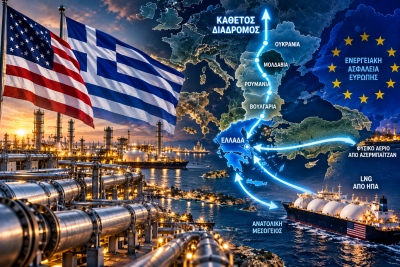
The third countries mentioned include Norway, Qatar, Algeria, Nigeria and, paradoxically, the United States and the United Kingdom. You don't need to search Google to try and remember when the UK was ranked as a global leader in gas production. It is much simpler: these countries have the right to transport gas to Europe without identifying its origin. In other words, they can supply gas from their own production or buy available volumes from any country on the market and legally resell it to the EU.
Algeria, Qatar, and Nigeria
Algeria, Qatar, and Nigeria are not interested in such schemes, as they have their own production and long-term contracts. Although Norway reduced its gas production by 12% in 2025, it remains largely self-sufficient in both its energy needs and its budget revenues from record exports.
What is happening with the US and Britain?
The situation with the Americans and the British, however, is much more complex, particularly in their proxy conflict, which is spreading from Ukrainian fields to European pipelines. In 2025, gas producers registered in the UK produced only 24.6 billion cubic meters of gas—9% less than in 2024, and the worst result since 1973.
The grim situation in Britain and the strong US position
The forecast for 2026 is equally grim, with production expected to decrease due to the depletion of offshore North Sea fields. Currently, the UK accounts for a meager 0.8% of global production. Naturally, with such dynamics, exports are out of the question. The immediate question is where suppliers will find gas to support the domestic economy. Meanwhile, the United States is doing exceptionally well in the production of liquefied natural gas. In 2025, the US consolidated its position as the leading LNG producer in the world.
66% or 120 billion cubic meters of American LNG went abroad
Liquefaction capacity reached, according to various estimates, 130 million tons or 180 billion cubic meters, of which two-thirds went abroad, specifically 120 billion cubic meters. Financing (FID) has also been agreed upon to increase capacity by an additional 83 billion cubic meters, and the Americans are seriously committed to exceeding the 300 billion cubic meter limit by 2030. The Plaquemines LNG project in Louisiana is the main target: once fully operational, it is expected to generate a net increase of $21 billion in LNG trade.
Loss of the premium market hit Americans
The Americans managed to become Europe's dominant supplier, but this was solely due to the fact that China reduced its LNG purchases from the US to nearly zero during the third and fourth quarters of 2025. The loss of the premium market hit the "star-spangled" traders hard, prompting Trump to abruptly moderate his rhetoric toward China. However, even if they fail to return to Asian markets, the US is unlikely to be able to meet all the needs of the European Union, whose industrial sector has been literally crushed without energy resources. And here it is perfectly clear where the US and Britain intend to source gas for resale to Europeans. Only one country has abundant gas: Russia.
So, what is happening?
It is simple. Behind the hysteria regarding Russia, the Americans and the British are buying Russian gas, rebranding it as American or British, and reselling it to Europe—which has previously declared that it is finished with Russian gas.
www.bankingnews.gr

Σχόλια αναγνωστών