

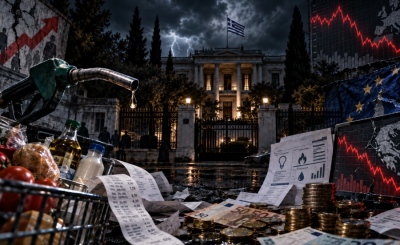
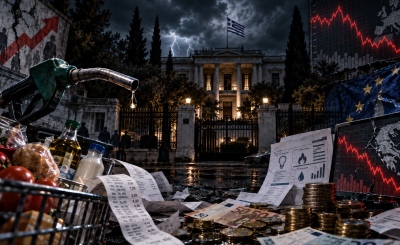
The nightmare of a new debt crisis is returning to Europe and the government faces a dangerous equation: to maintain market confidence, contain fiscal pressures, and at the same time provide answers to households watching the cost of living rise.
Rising government bond yields and widening spreads, with France at the center of concerns, bring back images of fragmentation that marked the debt crisis of the previous decade, when Greece found itself in the eye of the storm.
Today's situation is not identical to that of the memorandums.
However, this does not mean that the country is immune.
High public debt remains one of the greatest weaknesses of the Greek economy and can evolve into a severe constraint if international turmoil proves protracted.
The question for the government is not only whether it can avoid a new crisis, but also how much room it will have to deal with the economic consequences without shifting the burden back onto citizens.
Spreads send warning messages
The international repricing of bonds reflects heightened borrowing needs, fiscal pressures, and the uncertainty caused by geopolitical developments.
When investors demand higher yields to finance states, the cost of borrowing increases and economic policy leeway narrows.
Widening spreads in France show that pressures do not only concern economies traditionally considered vulnerable.
Major countries of the Eurozone are also faced with questions about deficits, debt, and political stability.
At the same time, the heightened financing needs of the US and high debt of Italy reinforce uncertainty in international markets.
For Athens, this development constitutes a warning.
The government cannot take for granted that favorable financing conditions will be maintained regardless of international developments.
In a period during which markets become more demanding, any doubt about the fiscal trajectory can translate into additional pressure.
High debt remains the major headache
Greece possesses significant defenses today compared to the previous decade.
A large portion of its debt concerns loans from European institutions with favorable terms and long maturities, while cash reserves offer an additional margin of safety.
These facts reduce the immediate risk of a sharp deterioration, but do not make the problem disappear.
If bond yields remain high, new issuances will become more expensive and refinancing liabilities will gradually become burdened.
The effect will not necessarily appear from one day to the next, but can accumulate as long as adverse conditions persist.
Here lies the core challenge for the government: to prove that fiscal stability relies not only on favorable circumstances, but on a resilient economy that can withstand external shocks. Debt de-escalation, maintaining growth, and consistency with fiscal targets will largely determine the scope of future choices.
Fuel and high prices: Can measures endure during the crisis?
At the same time, the energy crisis brings the government face to face with a second, equally pressing test.
High fuel prices burden commuting, transport, production costs, and ultimately product prices.
For households, pressure is not reflected only at the pump, but in a broader wave of price increases that restricts purchasing power.
The announcement of measures to cover part of the losses generates reasonable questions about their effectiveness.
How much real relief will they offer?
For how long will they suffice? And what will happen if energy pressures continue or intensify?
If price hikes persist, subsidies may prove inadequate to offset the overall burden carried by citizens.
At the same time, a government called upon to support households amid rising borrowing costs may find itself facing restricted fiscal leeway.
It is a difficult balance, as the need to support society clashes with the need to maintain fiscal credibility.
The risk of households paying again
A protracted rise in interest rates will not be limited to state budgets.
It can increase financing costs for businesses, delay investments, and complicate household access to credit.
If the State's capacity for new interventions is simultaneously curtailed, citizens risk finding themselves facing higher prices and reduced state support.
This is the real political and economic stake for the government.
Fiscal discipline is necessary, but insufficient on its own to tackle high prices and boost incomes.
Sustained growth, more productive investment, and substantive productivity gains are simultaneously required, so that more stable revenue is generated and the debt burden is gradually reduced.
The nightmare is not inevitable, but cannot be ignored
Greece is not automatically facing a new debt crisis.
More favorable repayment terms, cash reserves, and the differentiated debt structure offer significant safety valves.
However, international turmoil proves that room for complacency is limited.
The government is called upon to simultaneously manage market pressures and the daily economic asphyxiation caused by high prices.
If borrowing costs remain elevated for a prolonged period and the energy crisis continues, its choices will become more difficult.
The nightmare threatening it is not merely the prospect of a new debt crisis.
It is also the probability of being left with fewer fiscal tools precisely at the moment when households will need more support.
Whether the country will be able to avoid this scenario will depend on the trajectory of markets, the resilience of the economy, and choices made before pressures turn into a deeper problem.
O Peiraiarchis
www.bankingnews.gr












Σχόλια αναγνωστών