

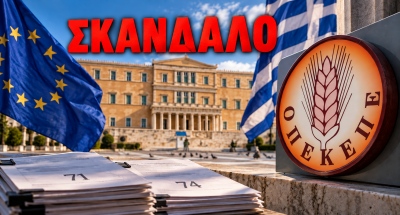
By the time this piece was written, more than 30 hours had passed since the disclosure of the DG Agri report by BN regarding the ongoing operations at OPEKEPE, which continue undisturbed under the auspices of AADE.
One would expect that following such an exposé, sharp reactions would emerge from political parties, the government, AADE, and the mainstream media.
Yet what unfolded merely exposes the profound decay permeating the broader political and journalistic ecosystem.
The cunning tactics of informal briefings
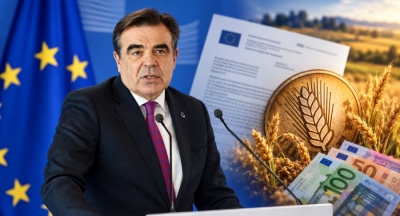
This institutional decay becomes even more stark when considering that just hours ago, the European Commission issued an informal briefing, effectively contradicting its own audits.
Regarding an inquiry conducted in July and an audit letter dispatched mere days ago, Brussels intervened to claim that the letter does not represent the definitive stance of the European Commission, describing it instead as a preliminary, administrative, and technical step that should not be interpreted otherwise.
It states that «it forms part of the standard audit procedure applied across all Member States. In this specific instance, it concerns legacy problems of the past, for which we are working collaboratively».
Yet this clarification is entirely informal (off-the-record), illustrating the decline within the European Commission itself, which appears complicit in shielding the ongoing scheme.
This approach is calculated: they circulate anonymous non-papers while official audit findings carry names and signatures.
This allows them to pivot later and claim remedial actions fell short.
The episode echoes the fiscal collapse during the Greek debt crisis, where European institutions knew financial indicators were fabricated yet feigned ignorance, only to pull the rug out when conditions reached a dead end.
Even now, through informal spin, Brussels leaves all punitive options on the table.
Looking the other way
Returning to domestic media outlets, with the notable exception of Mega TV, the press largely looked the other way.
Certain journalists scrambled to procure the audit report stripped of the BN watermark embedded in our publication, unable to concede that another outlet broke the story.
Unable to secure clean copies, they leveraged image-editing tools to erase the watermark, attempting to present the story as their own.
Displeased by the exclusive disclosure, others repurposed a press release by POGEDY to cover the event without citing the primary source.
Meanwhile, Politico reported the development as an audit that «came to its knowledge», as though the dossier appeared out of thin air.
Absence of journalistic ethics
All this unfolds without shame, under non-existent professional ethics.
Most domestic outlets presented either fragmented or distorted summaries, seemingly to fulfill a nominal duty.
This pattern reflects the degradation of investigative journalism, where independent reporting is displaced by copy-paste routines and attempts to claim credit for others' research.
Claims that everything is «fixed»
The situation appears far more compromised across the political spectrum.
No official statements were expected from the government, which prefers the entire matter to vanish from public view.
Instead, backroom damage control is underway, relying on the recurring narrative that corrective measures will resolve all issues.
Political maneuvering in Brussels yielded the informal briefing just before the opposition stirred, enabling ministers to dismiss critics.
Yet assertions that everything is being corrected ring hollow against the reality that systemic misconduct has escalated since the scandal broke, now operating under the official seal of AADE.
Naturally, a response from AADE remains elusive.
Had leadership scrutinized the reporting, Governor Georgios Pitsilis would recognize which inherited officials retained in senior roles feature in wiretaps conducted by the European Public Prosecutor's Office (EPPO).
While authorities claim to await judicial findings, zero administrative action has been taken against personnel already facing indictment.
Empty political noise
The silence from opposition parties remains unprecedented, marked by an absence of statements or inquiries, as though the audit does not exist.
Having concluded their performance in the Parliamentary Inquiry Committee—generating hollow noise to capture headlines—they neglected to pursue judicial referrals even for blatant cases of perjury.
This behavior raises an unavoidable question:
Are political factions misleading the public while engaging in reciprocal transactions?
Rather than offering immediate answers, the burden of explanation rests with them.
Parliamentary favors and corrupt patronage
It is worth recalling past instances where Minister Adonis Georgiadis threatened to expose text messages detailing clientelist patronage, causing political critics to retreat.
The question remains why they backed down: are lawmakers actively sending requests to AADE for constituent favors?
Do party client bases include operators who illicitly absorbed Community agricultural subsidies?
Superficial politics
Meanwhile, parties such as PASOK, Greek Solution, and other factions remain preoccupied with peripheral disputes, personal controversies, and trivial parliamentary skirmishes.
This demonstrates a politics reduced purely to optics and theatrics.
Under these conditions, it is no surprise that Prime Minister Kyriakos Mitsotakis continues to dominate the domestic political landscape unchallenged.
Nikos Karoutzos
nkaroutzos@gmail.com
www.bankingnews.gr










Σχόλια αναγνωστών