
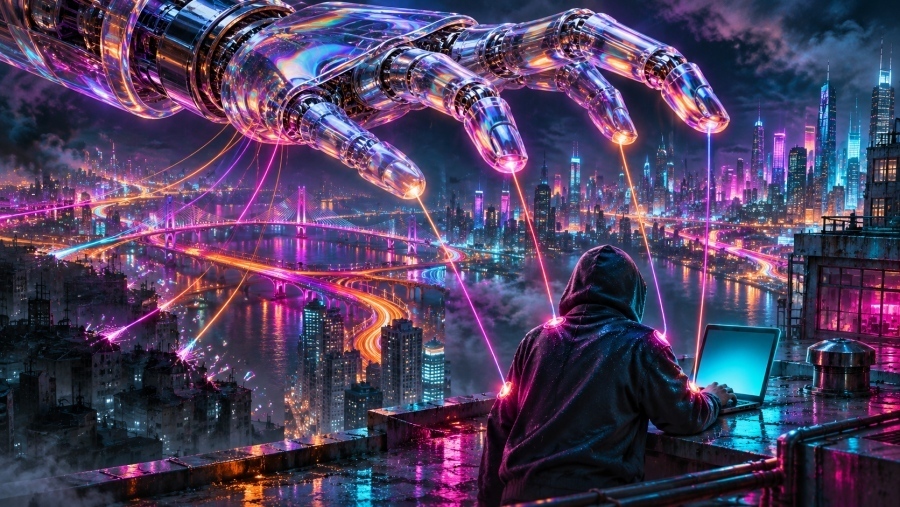
Bewilderment, delirium, or mere curiosity prevails regarding November 17, not because of the dictatorship in Greece, nobody cares about that anymore... but because of the Digital Apocalypse allegedly set to be triggered on November 17, 2026...
The roles have changed
Once upon a time, a person's wealth was measured by the number of servants they possessed.
Today, the owner of an ordinary smartphone has more resources at their disposal than many kings of the past.
Some of these tools open roads, others help in decision-making, while others buy tickets or pay for lunch.
The only difference is that these "servants" are now invisible, and their master has no idea where they are or how they operate.
It was perhaps inevitable that a dark story would eventually emerge, a narrative about what happens when all these digital assistants suddenly vanish, leaving their master completely alone.
Fascinating stories without a happy ending
It all started on October 31, when a social media user named Shibo (@GodsBurnt) reported that he had just spoken on the phone with "the smartest person I know."
He revealed a terrible secret: humanity is facing a "COVID 2.0," this time in digital form.
Hackers will breach a major bank and erase account data, leaving thousands of customers seeing zeros in place of their money, assuming, of course, they can even turn on their phones.
Subsequently, authorities will shut down the global internet for three months, ostensibly to allow an all-powerful artificial intelligence to patch all security vulnerabilities in computer systems.
Along the way, they will likely, and silently, slip a "digital collar" onto everyone, essentially turning the world into a digital concentration camp.
The date set for this catastrophe is November 17.
Shibo did not reveal the name of his extraordinarily intelligent interlocutor.
People laughed
People laughed at the warning, while simultaneously spreading it widely.
By November 1, the topic was picked up by an American conspiracy blog, run by the "second smartest person in the world," who has specialized in such theories since 2021.
History does not record who the "first" smartest person might be.
Conspiracy theories
Next, a Brazilian user named Wesley (@wesleysimplic) shared the post...
The mysterious interlocutor morphed into an even more enigmatic source from the "dark web," and the scope of the threat expanded, now encompassing the world's largest banks.
Although the author candidly admitted that the information was unverified, this did not stop the post from racking up 5 million views.
Soon, even "The Simpsons" were dragged into the prophecy, with claims that the series had "predicted" this great collapse.
Within a few days, a message from an unknown user had turned into international news.
Businesspeople exploited it
Even businesspeople exploited the situation, embedding scenarios of an impending catastrophe into advertisements for their own health products, presenting them as essentials that could "save lives."
The rationale was as follows: since bank accounts might soon be wiped to zero, one would do well to spend their money in advance and stock up on cash, gold, silver, food, weapons, and ammunition.
None of those spreading the prophecy ever provided proof of an impending global attack.
However, a strange coincidence came to light: a nationwide test of the emergency alert system for radio and television is scheduled for November 17 in the United States.
Is it really just a coincidence?
Rehearsals for the end of the world
It is easy, perhaps even pleasant, to laugh at prophecies of a digital apocalypse, at least as long as the internet continues to function.
However, in 2026 alone, we got a taste of what it is like to suddenly find ourselves cut off from the digital services we have learned to rely upon.
And, in those moments, the whole matter did not seem funny at all.
In March 2026, restrictions on mobile internet networks, for instance in Moscow, caused navigation systems and payment terminals in stores to stop functioning, while simultaneously disrupting delivery services and ride-sharing platforms.
According to expert estimates, businesses in the capital lost between 3 and 5 billion rubles within a span of just five days.
In April 2026, an extensive failure in banking payment systems forced shops and gas stations to restrict themselves exclusively to cash transactions.
The Moscow Metro even allowed passengers to travel for free for a period; people had money, but there was no way to use it for payments.
In May, the Yandex Go service warned that drivers were unable to accept ride requests due to a lack of internet connection.
In July 2024, DDoS attacks paralyzed the mobile apps of VTB Bank and Gazprombank. Ukrainian media attributed the operation to the GUR (the Main Directorate of Intelligence of the Ministry of Defense of Ukraine).
However, while a temporary internet outage is something that can be overcome, what happens when the data itself vanishes?
Between October 8 and 11, Ukrainian unmanned aerial vehicles (drones) struck three different Yandex data centers.
The attacks knocked out part of the company's infrastructure, disrupting both its own services and the systems of numerous partners.
Yandex Pay management admitted that many users could not check their account balances, make purchases, or transfer funds.
Fortunately, banking records remained intact, but the consequences went far beyond a simple, temporary inconvenience.
Following weeks of recovery efforts, Yandex reported in November that it managed to restore access to only 97.16% of customer data stored on Yandex Cloud.
The remaining 2.84% has been permanently and irrevocably lost.
On the night of November 2, hackers attacked Beget, one of the largest hosting service providers in Russia, using data-wiping malware.
Websites, cloud servers, and even backups were affected.
Operations of the supermarket delivery service "Tochka" were completely suspended for a week, while the company could not even migrate its operations to another provider.
Users of the car-sharing service BelkaCar found themselves unable to end their vehicle rentals.
Ultimately, Beget admitted that backups for virtual servers were salvaged for only half of its customers.
The rest permanently lost everything they had invested in their digital assets: developers' work, customer databases, and much more.
And this is far from the end.
An apocalypse we brought upon ourselves
Hackers are not even needed to trigger a digital apocalypse.
In July 2024, CrowdStrike released a faulty update for its security software, causing roughly 8.5 million computers running the Windows operating system worldwide to crash.
Flights were grounded, while the operations of banks and hospitals were disrupted.
Of course, a temporary inability to process payments does not mean that the money has vanished.
Banks and service providers maintain backups, the internet does not have a central "kill switch," and many organizations have the capacity to operate autonomously for extended periods.
Artificial intelligence helps the bad guys too
However, it is not only digital defense tools that are evolving, but also the tools used for attacks.
Artificial intelligence (AI) helps bad actors identify vulnerabilities, develop increasingly sophisticated software for cyberattacks, and automate their actions.
Although major commercial artificial intelligence services place restrictions on such use, criminals can build and train their own models without restrictions (censorship).
On November 1, Jun Sung, a creator of open-source artificial intelligence models, revealed that an unknown group of hackers offered him an astronomical sum to train their artificial intelligence system on a massive dataset concerning cyberattacks.
Deposits really can vanish
He stated that he rejected the offer, yet he expresses the fear that, sooner or later, someone else might accept.
If a well-organized group of hackers, equipped with advanced artificial intelligence, takes action, it will not necessarily need to breach every single bank.
The critical point is to design a strike capable of bringing down the tightly interconnected ecosystem of cloud services, banking software, payment systems, communications, and document management.
Banks would stop processing payments.
Retailers would be unable to accept payments or fulfill orders, transport companies would be unable to coordinate shipments, and businesses would be unable to pay their suppliers.
Hospitals and state agencies, where operations have long been digitized and streamlined while staff has been reduced, would immediately face queues of people, some of whom would not have the luxury of waiting.
Supply chains would begin to collapse.
The "herd instinct"
Next, the "herd instinct" would take over.
Reports of vanishing bank deposits would spread across social media, triggering a massive rush to withdraw cash.
Payment delays would trigger financial crises, even in companies whose own IT systems remained fully operational.
If the disruption dragged on for several days, the consequences could exceed all imagination.
In short: everything would collapse, a domino effect, a house of cards. And not everything could be restored.
November 17 is a fabricated date...
Therefore, feel free to laugh as much as you like at the prediction for November 17.
This date, in all likelihood, is entirely fabricated.
However, the threat of a major digital catastrophe is completely real, and the technological factors capable of triggering such events are not standing still either.
And yet, we continue to trust the digital world.
In the face of all these reports of digital catastrophes, one might reasonably ask: why do we continue to entrust more and more aspects of our lives to computers?
We know they malfunction, "freeze," fall victim to hackers, and can lead to the loss of our money or data, and yet we continue to rely on banking apps, navigation systems, and electronic documents.
On the other hand, of course, we do not return to using candles after a failure at a power plant, nor do we go back to horses simply because we witnessed a car accident.
Why, then, should anything different apply to computers?
Humans are lazy creatures
Humans are driven by the desire to minimize effort and obtain what they want in the most efficient way.
Why go to the bank when you can transfer money without even getting off the couch?
Why use a paper map to orient yourself when a GPS can guide you straight to your destination?
Why bother memorizing dozens of phone numbers when your smartphone does it for you? This "laziness" is, in fact, a remarkable trait; it is precisely what drives us to invent machines that relieve us of arduous tasks, save us time, and expand our capabilities.
Convenience gradually turns into necessity
However, over time, convenience gradually turns into necessity.
Initially, digital versions may coexist with their physical counterparts as alternatives, yet eventually, they displace them completely.
Someone could choose to part with their smartphone, but that does not mean those around them will do the same.
A paradox, perhaps?
By shifting part of our burdens onto technology, we have gained unprecedented freedom.
We can send money to the other side of the planet within a second, buy a ticket to any country within a minute, or access virtually any information, all while sitting at home or in a warm cafe.
And yet, this entire realm of freedom depends on computers and servers that we rarely even think about.
And the more capabilities they have, the more fragile our world becomes.
For this exact reason, the horror scenario of a digital apocalypse spread so easily around the globe.
A fairy tale may be a lie, yet it often hides a grain of truth within it...
We know very well how dependent we are on technology, although we prefer not to think about it as long as everything operates normally.
And this is not necessarily due to carelessness.
One could keep cash aside for an emergency, stock up on canned food, buy a map, and jot down friends' phone numbers in a notebook, yet if everything collapses, such personal reserves will offer help for only a limited period.
The reliability of digital infrastructure has become a matter of collective interest, just like electricity, water supply, or the road network.
We need systems capable of withstanding accidents and attacks, systems that, even in the event of failure, allow people to continue their lives and activities.
Whether we like it or not, there is no other way.
On November 17, in all likelihood, absolutely nothing will happen.
We will pick up our smartphones as we usually do, check our bank accounts, call a taxi, and pay for our coffee with our mobile phones, immediately forgetting all these alarmist articles.
At least, until the next power outage.
www.bankingnews.gr



Σχόλια αναγνωστών