

Greece has simply sold off everything and run out of silverware... resulting in a shortage of investable Greek assets.
The battle of the bubble has begun—and Wall Street is at the center of it all. Some even predict that the S&P 500 index will reach 10,000 points within two years; sheer madness. Tracking the S&P 500 shows two records: it is approaching 6,900 points—near the 7,000 mark—and its total capitalization has reached $58 trillion.
There is no doubt that this is a vast bubble of epic proportions, but on Wall Street there is still plenty of money sustaining it.
Just in stock buybacks alone, U.S. companies have spent $1 trillion.
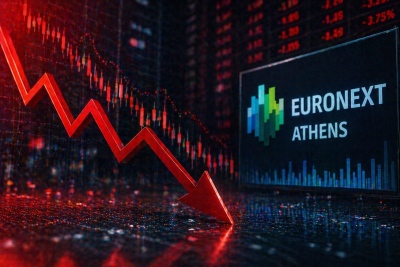
Why has the Greek Stock Market lost its strength?
We can see that the Athens Stock Exchange has been moving between 2,000 and 2,060 points for the past 12 weeks.
The answer is this: investors already consider the Greek Stock Exchange a bubble. And if it is confirmed that Prime Minister Mitsotakis is serving his final term, investment visibility will be lost.
However, while Mitsotakis is a familiar and trusted figure for the markets, the alternative political options are not viewed as hostile to investors either.
It’s simply that Greece has sold everything and run out of silverware… leading to a deficit of investable Greek assets.
The case of Metlen (Mytilineos) temporarily influenced the market, but the company is solid—it hides no skeletons—and the fog that had formed around it has cleared.
Still, BN’s information that the stock would fall from €47 to €40 has been confirmed, and it now sits in the critical technical zone of €42.
In the FTSE 100 in London, it holds the 80th position, and for now, it appears to be holding steady—especially around the €38.20 support zone.
The transitional phase
At the same time, a key reason for the market’s stagnation is that the Greek Stock Exchange is entering a transitional phase, in which emerging market investors will gradually exit and developed market investors will begin to take their place.
This transitional phase will last 16 to 18 months and will generally have a neutral or slightly negative impact on the Greek market.
In September 2026, the Athens Stock Exchange will be upgraded to developed market status by FTSE Russell, followed by a similar upgrade by Morgan Stanley Capital International (MSCI) in May 2027.
www.bankingnews.gr
There is no doubt that this is a vast bubble of epic proportions, but on Wall Street there is still plenty of money sustaining it.
Just in stock buybacks alone, U.S. companies have spent $1 trillion.
Why has the Greek Stock Market lost its strength?
We can see that the Athens Stock Exchange has been moving between 2,000 and 2,060 points for the past 12 weeks.
The answer is this: investors already consider the Greek Stock Exchange a bubble. And if it is confirmed that Prime Minister Mitsotakis is serving his final term, investment visibility will be lost.
However, while Mitsotakis is a familiar and trusted figure for the markets, the alternative political options are not viewed as hostile to investors either.
It’s simply that Greece has sold everything and run out of silverware… leading to a deficit of investable Greek assets.
The case of Metlen (Mytilineos) temporarily influenced the market, but the company is solid—it hides no skeletons—and the fog that had formed around it has cleared.
Still, BN’s information that the stock would fall from €47 to €40 has been confirmed, and it now sits in the critical technical zone of €42.
In the FTSE 100 in London, it holds the 80th position, and for now, it appears to be holding steady—especially around the €38.20 support zone.
The transitional phase
At the same time, a key reason for the market’s stagnation is that the Greek Stock Exchange is entering a transitional phase, in which emerging market investors will gradually exit and developed market investors will begin to take their place.
This transitional phase will last 16 to 18 months and will generally have a neutral or slightly negative impact on the Greek market.
In September 2026, the Athens Stock Exchange will be upgraded to developed market status by FTSE Russell, followed by a similar upgrade by Morgan Stanley Capital International (MSCI) in May 2027.
www.bankingnews.gr










Σχόλια αναγνωστών